
Understand the method.
For , integrate the nonnegative speed. Omit the third squared component for a two-dimensional path.
Take the magnitude before integrating
Over a short time interval , the displacement is approximately . Its length is approximately . Adding these small lengths gives the arc-length integral.
The order matters: first differentiate, then take the magnitude, then integrate. With position in metres and time in seconds, speed is in m/s and the resulting length is in metres.
Simplify speed and check its sign
Square the derivative components, add them and simplify before integrating. A trigonometric identity may make speed constant; a polynomial expression may allow a simple substitution.
Remember . Remove the absolute value only after checking the parameter interval. If an antiderivative is outside the course techniques, set up the correct definite integral and use appropriate numerical technology.
Count every part of the journey
Arc length counts the whole route, including repeated or retraced sections. Displacement is the vector from start to finish; its magnitude is direct endpoint separation.
For a smooth path, length is at least the endpoint separation. Returning to the starting point can give zero displacement while the distance travelled remains positive.
See the method in action.
Simplify a curved path’s speed
Find the length of for , with coordinates in metres.
Worked solution
- 1
Differentiate and take the magnitude.
Factor out of the square root, retaining the absolute value at this stage.
- 2
Use the interval to remove the absolute value.
Here , so . The magnitude is nonnegative throughout the interval.
- 3
Substitute and change the limits.
The factor is exactly the derivative of the expression inside the root.
- 4
Evaluate the definite integral.
Subtract the lower-bound value after evaluating the antiderivative at both bounds.
The curve length is metres.
Separate two turns from zero displacement
A particle follows metres for seconds. Find its distance travelled, displacement and endpoint separation.
Worked solution
- 1
Find speed, including its magnitude.
The particle moves at m/s around a radius- circle.
- 2
Integrate speed over the full interval.
m.The interval covers two complete turns. Both turns add to the distance.
- 3
Subtract the endpoint positions.
The particle returns to its start. Neither displacement nor its magnitude records the intervening journey.
Distance m; displacement m; endpoint separation m.
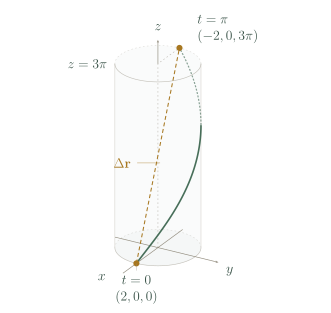
Measure a cable around a cylinder
A cable follows metres for . Find the cable length. Compare it with direct endpoint separation.
Worked solution
- 1
Differentiate the three coordinates.
The cable makes a half-turn around a radius- cylinder while rising by m.
- 2
Simplify the magnitude and integrate.
The magnitude is constant. Integrate it over the parameter interval of length .
- 3
Calculate the endpoint displacement.
The dashed straight chord joins the same endpoints but cuts across the curved route.
Cable length m, greater than the endpoint separation m. The curved route requires the arc length.
Try it yourself.
Calculate, explain, then apply.
Integrate a constant speed
Find the length of for , with coordinates in metres.
Show answer & reasoning
m.
The derivative is , with magnitude . Therefore m. This straight path also has endpoint separation m.
Count a retraced section twice
For metres on , find the distance travelled and displacement. Explain why the speed is not throughout.
Show answer & reasoning
Distance m; displacement m. Speed is , not .
Velocity is , so speed is . The particle goes from to and back to . Thus m.
Choose enough cable for a rising route
A guide cable must follow metres for . Ignoring fastening allowance, is an m reel long enough?
Show answer & reasoning
Yes. The required length is m, leaving about m.
The derivative is with magnitude . Hence . Compare the reel with route length, not the shorter direct distance between endpoints.
Keep practising
6 worksheet questions · 12 marks
Read the questions online
- Find length of on .2 marks
- Find length of on .2 marks
- Find length of on .2 marks
- Set up length for on without evaluating.2 marks
- Find length of on .2 marks
- For on , find distance and displacement.2 marks
Read the worked solutions
Equivalent correct methods earn the corresponding marks. Include units where asked.
- Find length of on .2 marks
Speed is .
Integrate over an interval of length .
- Find length of on .2 marks
The speed is .
Multiply by the parameter interval length.
- Find length of on .2 marks
Speed squared is .
Integrate constant speed .
- Set up length for on without evaluating.2 marks
The derivative is .
Take its magnitude before integration.
- Find length of on .2 marks
Speed is for nonnegative .
Use , so the integral becomes .
- For on , find distance and displacement.2 marks
Speed is integrated over interval length .
The path makes two full turns back to its start.
Distance ; displacement .
Curriculum reference & lesson scope
SACE Board of South Australia
Stage 2 Specialist Mathematics school Vector calculus: polynomial and trigonometric parameterisations, related coordinate rates, Bézier paths, componentwise differentiation and integration, motion, tangent directions, circular motion and arc length. Reasoning and proofs use these school topics; vector-field calculus is outside this chapter.
Official curriculum source ↗