
Understand the idea.
Distances define circles and bisectors
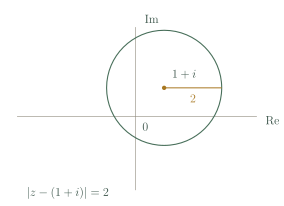
Read as the distance from the fixed point . The locus , for , is a circle. A strict inequality gives its interior without the boundary; a non-strict inequality includes the boundary.
For distinct fixed points and , the equality describes their perpendicular bisector. In Cartesian algebra, squaring both distances cancels the and terms, leaving a straight-line equation.
Arguments define directions, with missing endpoints
An argument condition fixes a direction from , giving a ray with its endpoint excluded. At , the expression is zero and has no argument. Any denominator inside an argument condition must also remain nonzero.
For several locus conditions, translate each into geometry or Cartesian equations, find their intersections, then check the original conditions. Equal non-negative distances can safely be squared; argument conditions still require the correct direction and any excluded points.
See the method in action.
A circle in Cartesian form
Describe and give its Cartesian equation.
Worked solution
- 1
Express the displacement in coordinates.
Subtracting the centre gives the vector from that centre to the variable point.
- 2
Write the distance equation.
The modulus is the Euclidean distance from .
- 3
Square and identify the locus.
Both sides of the distance equation are non-negative, so squaring is equivalent: this is a circle centred at with radius .
A circle centred at with radius 2; .
Equidistance gives a line
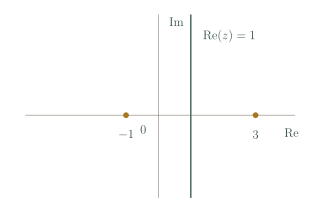
Find the locus .
Worked solution
- 1
Translate both distances.
The fixed points are and on the real axis.
- 2
Square and cancel equal terms.
Squaring preserves equality of non-negative moduli.
- 3
Solve the remaining linear equation.
The imaginary coordinate is unrestricted, so the locus is the vertical line .
- 4
Interpret the line.
It passes through the midpoint of the two fixed points and is perpendicular to the real axis.
, the line .
Try it yourself.
Check your understanding
Describe .
Show answer & reasoning
The open disc centred at with radius 3; boundary excluded.
The quantity measures distance from . Being strictly less than selects the open disc of radius and excludes every boundary point.
Keep practising
6 worksheet questions · 14 marks
Read the questions online
- Give the centre and radius of .2 marks
- Write as a Cartesian equation.2 marks
- Find the locus .2 marks
- Describe .3 marks
- Find the points satisfying and .3 marks
- A tracking system reports . Interpret its possible positions.2 marks
Read the worked solutions
Equivalent correct methods earn the corresponding marks. Include units where asked.
- Give the centre and radius of .2 marks
Write the expression as .
Centre ; radius 4. - Write as a Cartesian equation.2 marks
The real and imaginary differences are and .
. - Find the locus .2 marks
simplifies to .
The real axis, . - Describe .3 marks
must be a positive imaginary number. The point is excluded.
The vertical ray , . - Find the points satisfying and .3 marks
in gives . Both signs satisfy the circle.
. - A tracking system reports . Interpret its possible positions.2 marks
The inequality is a closed disc, rather than only its boundary.
All points at most 1 unit from , including the circle boundary.
Curriculum reference & lesson scope
SACE Board of South Australia
Stage 2 Specialist Mathematics complex numbers: Cartesian and polar representations, de Moivre, roots and roots of unity, Argand geometry and loci, complex factorisation and conjugate roots of real polynomials. Real-polynomial techniques are taught in the separate Real Polynomials chapter.
Official curriculum source ↗