
Understand the idea.
Treat y as a function of x
An implicit relation can describe several local branches without isolating . Differentiate the equation with respect to while treating as a function of . Thus by the chain rule.
A mixed term needs the product rule: . Write every derivative before collecting terms. Substituting a point too soon would turn changing coordinates into constants and destroy the relation you need to differentiate.
Collect the derivative terms
Gather the terms containing , factor it out, and divide by its coefficient only where that coefficient is nonzero. Check that a stated point lies on the curve before substituting it into the gradient formula.
A tangent uses the local gradient and point-gradient form. A normal has the negative reciprocal gradient when the tangent gradient is finite and nonzero. A zero denominator or a singular point needs separate investigation; division alone cannot classify it.
See the method in action.
Worked example
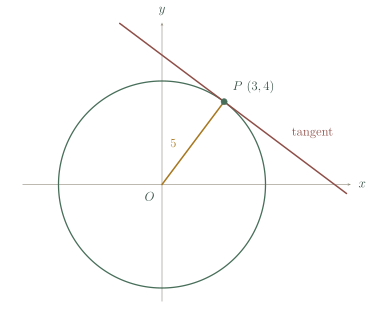
Find the tangent to at .
Worked solution
- 1
Check the point and differentiate.
The point lies on the circle, and differentiating y squared requires a chain factor.
- 2
Find the tangent gradient.
At the stated point, y is nonzero, so division is valid.
- 3
Write the tangent through the point.
Point-gradient form gives the line with gradient minus three quarters through (3,4).
- 4
Check the geometry.
The radius to (3,4) has gradient four thirds, confirming perpendicularity with the tangent.
.
Worked example
For , find and the normal at .
Worked solution
- 1
Check the point and differentiate the relation.
The point is valid; xy needs the product rule and y squared needs the chain rule.
- 2
Collect the derivative terms.
Factoring isolates the derivative where x plus 2y is nonzero.
- 3
Find the normal gradient.
The normal is perpendicular to the tangent, so their gradients have product minus one.
- 4
Write the normal line.
The normal passes through the same point as the tangent.
; normal: .
Try it yourself.
Check your understanding
Find for .
Show answer & reasoning
Implicit differentiation gives . Dividing by yields where ; the points with do not have a finite gradient from this formula.
Keep practising
6 worksheet questions · 12 marks
Read the questions online
- Find for .2 marks
- Find for .2 marks
- Find the tangent to at .2 marks
- Differentiate implicitly.2 marks
- For , identify points where the tangent is vertical.2 marks
- Find the gradient of at .2 marks
Read the worked solutions
Equivalent correct methods earn the corresponding marks. Include units where asked.
- Find for .2 marks
.
Divide by , where .
- Find for .2 marks
.
, for .
- Find the tangent to at .2 marks
The point satisfies .
at the point.
- Differentiate implicitly.2 marks
.
Collect .
- For , identify points where the tangent is vertical.2 marks
has a zero denominator at .
The circle then gives ; these are its left and right endpoints.
and - Find the gradient of at .2 marks
.
At , , so .
Curriculum reference & lesson scope
SACE Board of South Australia
Stage 2 Specialist Mathematics topic 6.1–6.2, with the approved school-level rates, differential-equation and motion applications.
Official curriculum source ↗