
Understand the method.
Here , and . Keep the same component order and use a vector constant for an indefinite integral.
Differentiate one coordinate at a time
A vector function gives a vector for each value of its parameter. Differentiate each coordinate using the usual scalar rules, and keep the coordinates in their original order.
A composite function still needs its chain-rule factor. A constant coordinate has derivative zero; it does not make the entire vector derivative zero.
Give every coordinate its own constant
Integrate each coordinate separately. The vector constant allows each coordinate to start at a different value.
Substitute the initial vector at the given time to find the constants. Then check both the derivative and the initial value: these are separate conditions.
Read a definite integral as displacement
Integrating velocity over a time interval gives the change in position. Evaluate the antiderivative at the upper time and subtract its value at the lower time, component by component.
Displacement joins the start to the finish. It does not measure the distance travelled along a curved or retraced path; that requires integrating speed.
See the method in action.
Keep the chain factors
For , find and .
Worked solution
- 1
Differentiate the power component.
Apply the ordinary power rule to the first component.
- 2
Differentiate the composite exponential and sine.
The inner derivatives are and . Include them before evaluating at a particular parameter.
- 3
Assemble the derivative and substitute zero.
Use and , keeping the original coordinate order.
and .
Recover position from an initial vector
A particle has velocity m/s and initial position m. Find , with in seconds.
Worked solution
- 1
Integrate each velocity component.
The antiderivatives form a family of position functions. Independent constants allow different starting coordinates.
- 2
Apply all three initial coordinates.
Equality of vectors means equality of each corresponding component.
- 3
Write the position and check it.
The derivative recovers the given velocity and the initial vector is correct.
metres.
Locate a robot and its displacement
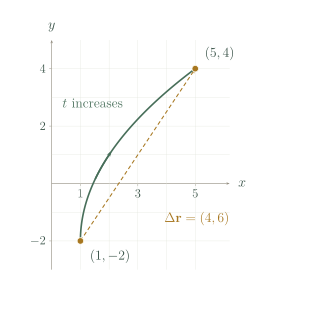
A robot starts at m and moves with m/s for seconds. Find its path, final position and displacement. Does the displacement magnitude measure its curved route?
Worked solution
- 1
Integrate velocity and apply the starting position.
The initial position fixes the translated location of the path.
- 2
Substitute the finishing time.
m.The graph follows the curved path from to as time increases.
- 3
Evaluate the definite velocity integral.
This agrees with . It is the straight start-to-finish vector shown dashed.
- 4
Interpret the magnitude.
m.This is the direct separation of the endpoints. The robot travels farther because its route curves between them.
The path is m; the final position is m and displacement is m. Its magnitude m is endpoint separation, not route length.
Try it yourself.
Calculate, explain, then apply.
Differentiate the components
Find the derivative of .
Show answer & reasoning
.
The cosine needs the chain factor and a minus sign. The power differentiates to and the constant differentiates to zero.
Check a proposed position
Given m/s and m, a student proposes m. Its derivative is correct. Is the position correct? Repair it if needed.
Show answer & reasoning
No. Its initial position is m. The correct position is m.
Differentiation removes both constants, so the derivative alone cannot check the starting location. The second coordinate must start at , independently of the first coordinate.
Find a survey probe’s endpoint
A probe starts at m with velocity m/s for seconds. Find its displacement and final position.
Show answer & reasoning
Displacement m; final position m.
Integrate: . Add this to to locate the endpoint. The displacement integral does not include the initial position.
Keep practising
6 worksheet questions · 12 marks
Read the questions online
- Differentiate for .2 marks
- Find the second derivative of .2 marks
- Integrate with initial position at zero.2 marks
- Evaluate .2 marks
- Given and , find position.2 marks
- Evaluate .2 marks
Read the worked solutions
Equivalent correct methods earn the corresponding marks. Include units where asked.
- Differentiate for .2 marks
Use the power rule.
The logarithmic coordinate requires a positive domain.
- Find the second derivative of .2 marks
The first derivative is .
Differentiate again.
- Integrate with initial position at zero.2 marks
Integrate each coordinate.
Use one constant for each initial coordinate.
- Evaluate .2 marks
Antiderivative .
Evaluate upper minus lower.
- Given and , find position.2 marks
Integrate to .
Initial values give .
- Evaluate .2 marks
Use antiderivative .
Subtract values at both endpoints.
Curriculum reference & lesson scope
SACE Board of South Australia
Stage 2 Specialist Mathematics school Vector calculus: polynomial and trigonometric parameterisations, related coordinate rates, Bézier paths, componentwise differentiation and integration, motion, tangent directions, circular motion and arc length. Reasoning and proofs use these school topics; vector-field calculus is outside this chapter.
Official curriculum source ↗