
Understand the method.
Evaluate both rates at the same parameter. A nonzero vector derivative gives the tangent direction even when no finite gradient exists.
Find the point and the two rates
A parametric curve gives both coordinates in terms of . Find the point by substituting into , then find the gradient by dividing the rate by the rate.
The chain-rule ratio is valid only when . Use the same parameter value in the coordinates and in both derivatives before writing the tangent equation.
Check zero rates before dividing
If and , the tangent is vertical: . If and , the tangent is horizontal: .
If both derivatives vanish, the ratio is indeterminate. Inspect a nearby derivative ratio and its limit, or the Cartesian curve. The zero vector alone does not decide whether a tangent exists.
Use a direction vector in three dimensions
When , it points along the tangent line. In three dimensions one scalar gradient cannot describe the line; keep the full direction vector.
Use a fresh parameter for the line. Its points lie along the local tangent, while the original traces the curve.
See the method in action.
Find a tangent with a finite gradient
Find the tangent line to , at .
Worked solution
- 1
Find the point on the curve.
The tangent must pass through the point at the specified parameter.
- 2
Differentiate both coordinates and form their ratio.
At , the denominator is , so the ratio is valid.
- 3
Use point-gradient form.
The line has the required gradient and contains .
.
Read a vertical tangent
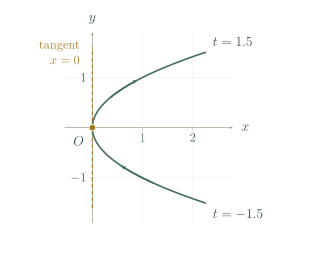
For , , find the tangent at . Explain why a zero rate does not remove the tangent.
Worked solution
- 1
Find the point and the derivative vector.
The point is the origin. The nonzero derivative vector points straight upward.
- 2
Check the gradient denominator.
Dividing by gives no finite gradient. These rates identify a vertical tangent.
- 3
Write the vertical line through the point.
The graph turns to the right of the origin, while its tangent at the origin is the vertical axis.
The tangent is . Its direction vector is nonzero, although the tangent has no finite gradient.
Point a probe along a 3D route
An inspection probe follows metres. At second, its sensor must point along the forward tangent. Give a suitable direction vector and a vector equation for the tangent line.
Worked solution
- 1
Locate the probe and differentiate the route.
The position supplies a point on the line, and the derivative supplies its direction.
- 2
Evaluate the direction at the same time.
This vector is nonzero and points in the direction of increasing . Normalisation is unnecessary because only direction is requested.
- 3
Use a new parameter to describe the tangent line.
At the line passes through the probe. Positive follows the forward tangent direction.
A forward direction is . The tangent is , .
Try it yourself.
Calculate, explain, then apply.
Find a point and a gradient
Find the tangent to , at .
Show answer & reasoning
.
The point is . Since and , the gradient at is . Substitute the point and gradient into point-gradient form.
Interpret a zero derivative vector
For , , both coordinate derivatives vanish at . Use for nearby nonzero to find the tangent there.
Show answer & reasoning
The tangent is , even though .
For , as . The nearby tangent direction therefore approaches the vertical direction. The curve passes through the origin, so the limiting tangent is .
Check a cart’s level heading
A cart follows , metres for seconds. At its lowest point, a straight inspection guide must match its tangent. Find the guide line and say whether the cart heads left or right.
Show answer & reasoning
The guide is m. The cart heads right through m at s.
The lowest point occurs at , giving ; confirms it is the minimum. Here , so the tangent is horizontal and the cart moves right. Substitution gives .
Keep practising
6 worksheet questions · 12 marks
Read the questions online
- Find for , nonzero.2 marks
- Find the tangent at for .2 marks
- Find the tangent at for .2 marks
- Use a limit to find the tangent at for .2 marks
- Give a vector tangent equation at for .2 marks
- Find the horizontal tangent of .2 marks
Read the worked solutions
Equivalent correct methods earn the corresponding marks. Include units where asked.
- Find for , nonzero.2 marks
Derivatives are and .
Divide rate by rate.
- Find the tangent at for .2 marks
The point is .
Gradient is .
. - Find the tangent at for .2 marks
The point is .
The derivative is , giving a vertical line.
. - Use a limit to find the tangent at for .2 marks
For nonzero , .
This tends to , giving a vertical tangent.
. - Give a vector tangent equation at for .2 marks
The point is .
The derivative there is .
. - Find the horizontal tangent of .2 marks
gives ; .
The corresponding point is .
.
Curriculum reference & lesson scope
SACE Board of South Australia
Stage 2 Specialist Mathematics school Vector calculus: polynomial and trigonometric parameterisations, related coordinate rates, Bézier paths, componentwise differentiation and integration, motion, tangent directions, circular motion and arc length. Reasoning and proofs use these school topics; vector-field calculus is outside this chapter.
Official curriculum source ↗