
Understand the idea.
Reflect negative outputs
The transformation acts on outputs. It keeps portions of the original graph on or above the horizontal axis and reflects portions below that axis upwards. Its outputs are always nonnegative.
For , use when and when . First locate where the inside expression changes sign, then write the appropriate rule on each interval. A sign-changing zero with nonzero slope produces a corner.
Reflect the right-hand graph
The transformation acts on inputs. Keep the original graph for and reflect that half into . The resulting graph is even, but its outputs can still be negative.
For example, is never negative, whereas reaches . Locate intercepts using the actual transformed equation, and check that solutions from each piece belong to the interval where that piece applies.
See the method in action.
A shifted V
Write piecewise and find its intercepts.
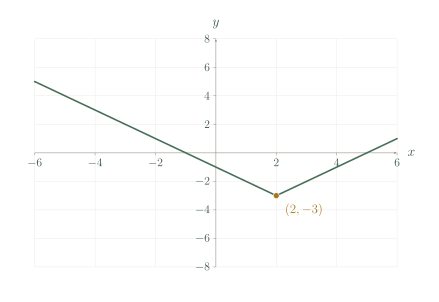
Worked solution
- 1
Split where the inside changes sign.
The sign of determines which absolute-value rule applies.
- 2
Write the two linear pieces.
The negative inside expression is reversed on the left of two and kept on the right.
- 3
Solve for the horizontal intercepts.
Both roots satisfy their branch conditions, giving intercepts and .
- 4
Find the vertical intercept.
The vertical intercept is ; the two pieces also meet at the vertex .
for , and for ; roots , y-intercept .
Reflecting part of a parabola
Find the turning points and zeros of .
Worked solution
- 1
Find where the inner quadratic is negative.
This central portion is reflected in the horizontal axis.
- 2
Write the graph in pieces.
The formulas agree at the two boundary zeros.
- 3
Locate zeros and corner minima.
Both zeros are minima. The left and right slopes differ at each, giving corner minima and .
- 4
Find the central turning point.
The central branch increases then decreases, so is a local maximum. The outer pieces are monotone on their respective domains, giving no other turning points.
Zeros ; corner minima ; local maximum .
Try it yourself.
Check your understanding
What is the minimum value of ?
Show answer & reasoning
-4.
Since , subtracting four gives . Equality occurs at , so the minimum value is .
Keep practising
6 worksheet questions · 20 marks
Read the questions online
- Write piecewise and find its intercepts.4 marks
- Find the turning points and zeros of .4 marks
- Solve .3 marks
- For , compare and .3 marks
- Give the domain, range and symmetry of .3 marks
- Solve and explain the interval.3 marks
Read the worked solutions
Equivalent correct methods earn the corresponding marks. Include units where asked.
- Write piecewise and find its intercepts.4 marks
Split at .
Solve each valid linear branch for .
for , and for ; roots , y-intercept . - Find the turning points and zeros of .4 marks
For , the rule is .
Outside that interval the rule is .
Zeros ; corner minima ; local maximum . - Solve .3 marks
or .
Check both values in the original equation.
or . - For , compare and .3 marks
The first reflects negative output upward.
The second mirrors the original right-hand graph into the left half-plane.
has vertex ; has vertex . - Give the domain, range and symmetry of .3 marks
It equals .
It is positive and unchanged when is replaced by .
Domain ; range ; even symmetry. - Solve and explain the interval.3 marks
.
Subtract 2; the distance from must be less than 3.
.
Curriculum reference & lesson scope
SACE Board of South Australia
Stage 2 Specialist functions and sketching graphs. Calculus-based analysis assumes concurrent Methods differentiation; real-polynomial division detail is taught in the separate Real Polynomials chapter.
Official curriculum source ↗