
Understand the idea.
The geometry of a fixed multiplier
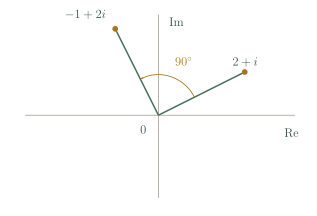
Multiplying by a fixed nonzero transforms every point about the origin. The modulus is the dilation factor; the argument is the signed rotation angle. Negative angles describe clockwise rotation.
The origin stays fixed. Multiplication by gives a quarter-turn anticlockwise, while gives a half-turn. Multiplication by zero collapses every point to the origin, so it has no inverse and no meaningful rotation angle.
Translation and inverse transformations
For , perform the multiplication first and then translate by . To undo this order, subtract first and then divide by : , provided .
For a pure multiplication taking a known nonzero to , solve to obtain . Describe the transformation using this multiplier's modulus and argument, rather than the coordinates of the image alone.
See the method in action.
A quarter-turn
Under , find the image of and describe the transformation.
Worked solution
- 1
Substitute the original point.
The map multiplies the entire complex number by .
- 2
Simplify the image.
The square of is .
- 3
Describe the multiplier geometrically.
Its modulus is one and its argument is , giving an anticlockwise quarter-turn about the origin.
; anticlockwise rotation through about the origin.
Recover the multiplier
A pure multiplication maps to . Find the multiplier and describe it.
Worked solution
- 1
Solve for the multiplier.
The input is nonzero, so division determines one multiplier.
- 2
Rationalise the denominator.
The conjugate product in the denominator is .
- 3
Find its scale and angle.
Equal positive coordinates place the multiplier halfway through the first quadrant.
- 4
State the transformation.
The map dilates by and rotates anticlockwise by about the origin.
; scale by , rotate anticlockwise by .
Try it yourself.
Check your understanding
Describe multiplication by .
Show answer & reasoning
Scale by 2 and rotate clockwise by about the origin.
The modulus doubles distances from the origin. The argument decreases each direction angle by , so the rotation is clockwise about the origin.
Keep practising
6 worksheet questions · 14 marks
Read the questions online
- Find the image of under multiplication by .2 marks
- Describe the map .2 marks
- A robot step is represented by . A turn-and-scale instruction multiplies it by . Find the new step.3 marks
- Find the multiplier taking to .2 marks
- Find the inverse of .3 marks
- Two instructions multiply successively by and . What is the combined transformation?2 marks
Read the worked solutions
Equivalent correct methods earn the corresponding marks. Include units where asked.
- Find the image of under multiplication by .2 marks
.
. - Describe the map .2 marks
.
Dilation of scale factor 3 and rotation through about the origin. - A robot step is represented by . A turn-and-scale instruction multiplies it by . Find the new step.3 marks
. The instruction scales by and rotates by .
. - Find the multiplier taking to .2 marks
Divide image by original: . Its modulus is 2 and quadrant-II angle is .
. - Find the inverse of .3 marks
Subtract 3 first, then divide by .
. - Two instructions multiply successively by and . What is the combined transformation?2 marks
The combined multiplier is .
The identity transformation.
Curriculum reference & lesson scope
SACE Board of South Australia
Stage 2 Specialist Mathematics complex numbers: Cartesian and polar representations, de Moivre, roots and roots of unity, Argand geometry and loci, complex factorisation and conjugate roots of real polynomials. Real-polynomial techniques are taught in the separate Real Polynomials chapter.
Official curriculum source ↗