
Understand the method.
Differentiate each coordinate. A turning point of one coordinate need not be a stop; rest requires every coordinate rate to be zero.
Keep all branches of a polynomial path
Polynomial coordinates can produce curved paths, reversals and loops. If , direct substitution eliminates the parameter; if , the sign of may still matter.
Use the original equations and parameter interval to check branches. Squaring a coordinate relationship can hide its sign and does not by itself establish the direction of travel.
A coordinate can turn while the particle keeps moving
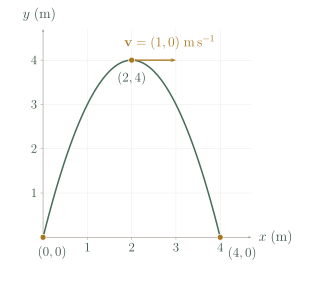
A maximum or minimum height is a turning point of the vertical coordinate. Find candidates using , then confirm the change using a sign test or a second derivative.
Check the other coordinate rate before claiming the particle stops. At a maximum height, it can still move horizontally. For an absolute maximum on a closed time interval, also check its endpoints.
Test complete positions and complete rates
A revisited point requires every coordinate to agree at two distinct parameter values. Repeated horizontal coordinates alone are not enough.
At rest means every coordinate rate is zero at the same instant. A repeated point does not imply a stop there, and a stop does not mean the particle stays there afterwards.
See the method in action.
Find a maximum height without inventing a stop
A particle has and metres for seconds. Find its greatest height and decide whether it stops there.
Worked solution
- 1
Differentiate the vertical coordinate.
An interior maximum height must have zero vertical rate.
- 2
Confirm the maximum and compare endpoint heights.
The curve is concave down, and the interior height exceeds both endpoint heights.
- 3
Check both coordinate rates at the maximum.
The horizontal rate remains nonzero. The particle continues moving horizontally at its greatest height.
The greatest height is metres at seconds, at . The particle does not stop.
Retain both branches after elimination
Eliminate from , for . State the restrictions and the traversal order.
Worked solution
- 1
Make equal even powers of the parameter.
This relation does not require choosing a square-root sign.
- 2
Use the allowed parameter values to establish the branches.
Negative gives negative and positive gives positive . Both branches occur, meeting at the origin.
- 3
Evaluate the endpoints and the central parameter value.
Increasing parameter order gives the lower branch towards the origin, then the upper branch away from it.
with , including both signs of , traced from through to .
Check whether a plotting head returns and stops
A plotting head follows , metres for seconds. Show that it returns to its starting point, and decide whether it stops anywhere.
Worked solution
- 1
Compare the endpoint positions.
Both coordinates agree at the two distinct times, so the starting point is revisited.
- 2
Differentiate each coordinate.
The chain rule applies to each power of .
- 3
Check the only time when the horizontal rate is zero.
At any other time the horizontal rate is nonzero; at the vertical rate is nonzero. The rates never vanish together.
It returns to metres at seconds, but it is never at rest during the journey.
Try it yourself.
Calculate, explain, then apply.
Calculate the coordinate rates
For and metres, with in seconds, find the position and velocity at .
Show answer & reasoning
Position metres and velocity m/s.
Substitution gives . Differentiate before substituting: .
Interpret an instant of rest
For metres with in seconds, is the particle at rest at ? Does that mean it remains at the origin?
Show answer & reasoning
It is at rest at that instant, but it does not remain at the origin.
, so both coordinate rates vanish. For any , the position differs from ; instantaneous rest is not permanent rest.
Apply a maximum-height test
A drone is modelled by , metres for seconds. Find its greatest height and say whether it stops there.
Show answer & reasoning
Greatest height metres at seconds; it keeps moving with velocity m/s.
at and . The height is , above both endpoint heights of metres. The nonzero horizontal rate prevents a stop.
Keep practising
6 worksheet questions · 12 marks
Read the questions online
- Eliminate from , .2 marks
- Find maximum for , , .2 marks
- Eliminate from , .2 marks
- Find velocity and acceleration for .2 marks
- For , find the point where vertical velocity is zero.2 marks
- For , show and give the same point.2 marks
Read the worked solutions
Equivalent correct methods earn the corresponding marks. Include units where asked.
- Eliminate from , .2 marks
.
Substitute into .
- Find maximum for , , .2 marks
gives .
The endpoints have ; the stationary value is .
at . - Eliminate from , .2 marks
Use .
Substitute into .
- Find velocity and acceleration for .2 marks
Differentiate each coordinate once.
Differentiate again.
and . - For , find the point where vertical velocity is zero.2 marks
.
Substitute into both coordinates.
At , point . - For , show and give the same point.2 marks
The squared coordinates are both .
Both coordinates are .
Both give .
Curriculum reference & lesson scope
SACE Board of South Australia
Stage 2 Specialist Mathematics school Vector calculus: polynomial and trigonometric parameterisations, related coordinate rates, Bézier paths, componentwise differentiation and integration, motion, tangent directions, circular motion and arc length. Reasoning and proofs use these school topics; vector-field calculus is outside this chapter.
Official curriculum source ↗