
Understand the idea.
Regular polygons on the unit circle
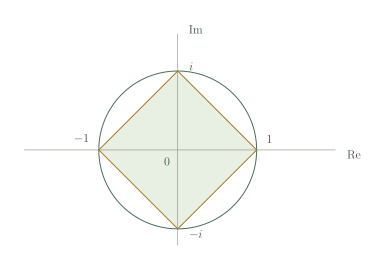
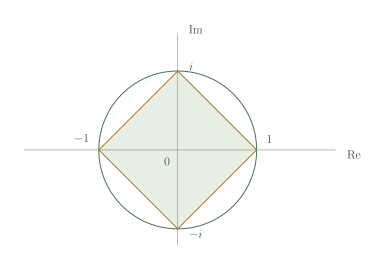
The roots of unity solve . Their common modulus is one, and their arguments are for . They form a regular polygon on the unit circle, with as one vertex.
Set . Then , so powers of repeat every exponents. Reduce an exponent modulo to replace a large power by one of .
Sums, inverses and conjugates
For , let . Multiplying by makes intermediate terms cancel: . Since , division gives .
A unit-circle point satisfies , so its conjugate is also its reciprocal. Non-real roots pair across the real axis. The real root , and also when is even, are their own conjugates.
See the method in action.
Work with cube roots symbolically
Let . Simplify .
Worked solution
- 1
Reduce the exponents modulo three.
The given cube root satisfies .
- 2
Establish the sum of the cube roots.
The difference of cubes factors exactly.
- 3
Use the nontrivial root.
The factor is nonzero, so the other factor must vanish.
- 4
Evaluate the original expression.
The reduced powers form the complete cube-root sum.
.
Measure a side of a root polygon
Find the distance between adjacent sixth roots of unity and .
Worked solution
- 1
Convert the second vertex to coordinates.
Exact trigonometric values locate the sixth root.
- 2
Find the displacement from the first vertex.
Distance between complex points is the modulus of their difference.
- 3
Calculate its modulus.
The squared coordinate differences sum to one.
.
Try it yourself.
Check your understanding
Find the sum of all fourth roots of unity.
Show answer & reasoning
.
The fourth roots are . Opposite roots cancel in pairs, giving .
Keep practising
6 worksheet questions · 14 marks
Read the questions online
- List all fourth roots of unity in Cartesian form.2 marks
- Let . Simplify .2 marks
- For , show that .2 marks
- Find the product of all fourth roots of unity.2 marks
- Show that the sum of the five fifth roots of unity is zero.3 marks
- A regular hexagon has vertices at the sixth roots of unity. Find its perimeter.3 marks
Read the worked solutions
Equivalent correct methods earn the corresponding marks. Include units where asked.
- List all fourth roots of unity in Cartesian form.2 marks
The angles are .
. - Let . Simplify .2 marks
, and every factor is 1.
. - For , show that .2 marks
Conjugation negates the argument; differs from by a full turn.
Both equal . - Find the product of all fourth roots of unity.2 marks
.
. - Show that the sum of the five fifth roots of unity is zero.3 marks
Multiply the sum by to get . Since , divide by .
, where . - A regular hexagon has vertices at the sixth roots of unity. Find its perimeter.3 marks
Adjacent vertices differ by a chord subtending , of length . There are six sides.
units.
Curriculum reference & lesson scope
SACE Board of South Australia
Stage 2 Specialist Mathematics complex numbers: Cartesian and polar representations, de Moivre, roots and roots of unity, Argand geometry and loci, complex factorisation and conjugate roots of real polynomials. Real-polynomial techniques are taught in the separate Real Polynomials chapter.
Official curriculum source ↗