
Understand the idea.
From points to displacements
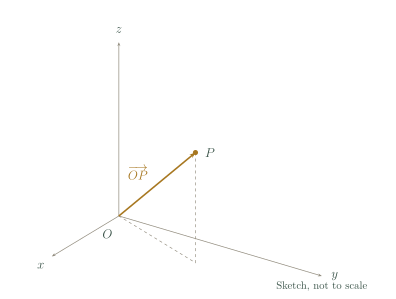
A point gives a location; a displacement vector gives a change of location. To find , subtract the starting coordinates from the finishing coordinates: . Reversing the journey reverses every component.
The three axes are mutually perpendicular, so Pythagoras extends to . Components may be negative because they record direction. Magnitude is a length and is always non-negative.
Separate length from direction
A unit vector has magnitude one. For nonzero , divide every component by to keep its direction while removing its length. The zero vector has no unit direction because this division would be by zero.
To construct a vector of length in the same direction, use . Keep exact fractions and radicals, then check the result's magnitude and its positive scalar relationship to the original vector.
See the method in action.
Worked example 1
Find the magnitude and a unit direction for .
Worked solution
- 1
Calculate the squared magnitude.
Perpendicular coordinate components combine by Pythagoras.
- 2
Take the non-negative square root.
Magnitude is a non-negative length.
- 3
Divide each component by the magnitude.
A positive division changes length to one while preserving direction.
Magnitude ; unit vector .
Worked example 2
A=(1,2,-1), B=(4,6,11). Find AB and a length-10 vector towards B.
Worked solution
- 1
Find the displacement from A to B.
The displacement is finishing position minus starting position.
- 2
Find the distance between the points.
The length of the displacement is the straight-line distance.
- 3
Scale its unit direction to length ten.
Normalising gives length one, then multiplying by gives the requested length toward .
- 4
Check the constructed length.
The scale factor is positive, so the vector also retains the direction from toward .
; vector .
Try it yourself.
Check your understanding
Can the zero vector be given a unit direction?
Show answer & reasoning
No.
The zero vector has magnitude zero and no preferred direction. The expression would divide by zero, so it cannot define a unit vector.
Keep practising
6 worksheet questions · 12 marks
Read the questions online
- Find the magnitude of .2 marks
- Find a unit vector along .2 marks
- Find the distance from to .2 marks
- Find a length-6 vector opposite to .2 marks
- Find positive when .2 marks
- A drone moves 6 m east, 3 m north and 2 m up. Find its displacement length.2 marks
Read the worked solutions
Equivalent correct methods earn the corresponding marks. Include units where asked.
- Find the magnitude of .2 marks
Add squares: .
Take the positive square root.
- Find a unit vector along .2 marks
The length is 5.
Divide every component by 5.
- Find the distance from to .2 marks
The displacement is .
Its squared length is .
- Find a length-6 vector opposite to .2 marks
The original length is 3.
Multiply by to reverse direction and double length.
- Find positive when .2 marks
.
Hence ; use the positive condition.
- A drone moves 6 m east, 3 m north and 2 m up. Find its displacement length.2 marks
The directions are perpendicular.
.
Curriculum reference & lesson scope
SACE Board of South Australia
Stage 2 Specialist Mathematics vector algebra, vector/Cartesian equations and linear systems. Original explanations and tasks.
Official curriculum source ↗