
From a path to its motion.
Start with position. Differentiate for velocity, then acceleration.
Differentiate position to describe motion
Position gives the coordinates. Velocity is how quickly position changes, including direction. Acceleration is how quickly velocity changes.
Differentiate each component separately, then differentiate again. For position in metres and time in seconds, velocity is in m/s and acceleration is in m/s².
Component form
Motion explorer
- Velocity
- Acceleration
- Path
Diagram details
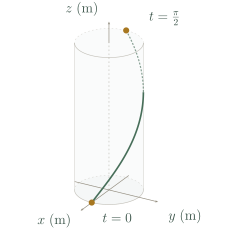
Both position axes use metres and the same scale: one square is 1 m. The solid path marks earlier times; the dashed path marks later times.
Arrow lengths share a display scale: 1 m/s of velocity or 1 m/s² of acceleration occupies 0.8 grid squares. Velocity is tangent to the path; acceleration points upward. Speed is the scalar length of the velocity vector.
0–4 s · Arrow keys: 0.25 s steps
- Position r
- Velocity v
- Acceleration a
- Speed |v|
- ≈ 1.41 m/s
Speeding up
Take the magnitude to find speed
Speed is the magnitude of velocity: how fast the object moves. Square the components, add, then take the square root. In 2D, leave out the third component.
At rest means every velocity component is zero at the same time.
Test whether speed changes
For nonzero speed, check the dot product of velocity and acceleration: positive → speeding up, negative → slowing down, zero → no instantaneous change in speed.
Zero at one instant does not mean constant speed over an interval. At rest, inspect the speed function directly; the rule below cannot be used.
Why this rule works
Square the speed, then differentiate both sides. Divide by only when .
See the method, and the reason.
Begin in two dimensions, extend to three, then interpret the motion.
Find motion along a curved path
An object has position metres, where is in seconds and . Find its velocity, acceleration and speed at .
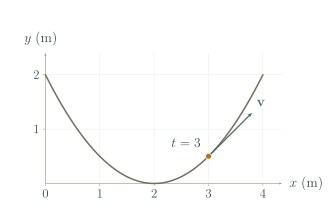
Worked solution
- 1
Differentiate each position component.
The derivative of is . The chain rule gives .
- 2
Differentiate velocity to find acceleration.
The horizontal velocity is constant; the vertical velocity increases by m/s each second.
- 3
Substitute the required time.
m/s and m/s².Differentiate the functions before substituting .
- 4
Take the magnitude of velocity.
m/s.The length of the velocity vector combines the two perpendicular components.
At : velocity m/s, acceleration m/s², and speed m/s.
Extend the method to three dimensions
A particle has position metres, with in seconds. At , find its velocity, acceleration and speed. Is it speeding up or slowing down?
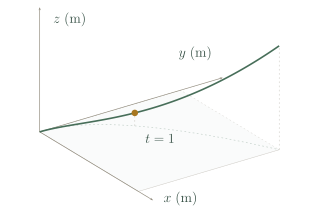
Worked solution
- 1
Differentiate all three components, twice.
and .The same component method works in three dimensions. Keep each component in its original position.
- 2
Evaluate both vectors at .
m/s and m/s².The two vectors are needed at the same instant to test the change in speed.
- 3
Find the length of the velocity vector.
m/s.Include all three squared components, even though one acceleration component is zero.
- 4
Calculate the dot product and interpret its sign.
The positive result means the particle is speeding up. Its speed changes at m/s² at this instant.
At : velocity m/s, acceleration m/s², and speed m/s. It is speeding up at m/s².
A minimum speed does not mean a stop
Return to metres for seconds. When is the object slowing down or speeding up? Is it at rest at ?
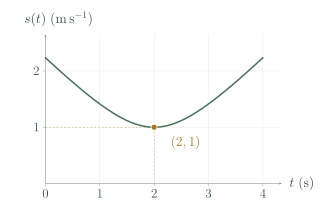
Worked solution
- 1
Form the velocity–acceleration dot product.
, , so .Here , so the sign test is valid throughout the interval.
- 2
Check the sign on each side of .
For , . For , .Speed decreases before and increases after it, so the minimum speed occurs at .
- 3
Check the entire velocity vector at .
m/s and m/s.The vertical motion pauses, but the object continues moving horizontally. Its velocity vector is not zero.
- 4
Interpret the zero dot product at this instant.
and at .Only the instantaneous rate of change of speed is zero. Acceleration is still m/s² and changes the direction of velocity.
Slowing down for ; speeding up for . At its minimum speed is m/s, so it is moving, not at rest.
Make the method yours.
Start with a calculation, interpret the motion, then apply the idea.
A constant coordinate
A particle has position metres, with in seconds. Find its velocity, acceleration and speed. Does the constant third component make it stationary?
Show answer & reasoning
m/s, m/s², and m/s. It is not stationary.
Differentiate each component. The constant height gives zero vertical velocity, while the horizontal components remain nonzero. Speed is m/s.
A negative dot product
At one instant, m/s and m/s². Find the rate of change of speed and decide whether the particle is speeding up or slowing down.
Show answer & reasoning
m/s². The particle is slowing down.
Speed is m/s. The dot product is , so divide by . A negative rate means speed is decreasing; speed itself is still positive.
A robot’s speed warning
A robot follows metres for seconds. Its warning activates above 4 m/s. At , should the warning be active? Is the robot speeding up or slowing down?
Show answer & reasoning
Yes: its speed is m/s. It is slowing down, with m/s².
Differentiate: and . At , , so . Also , giving m/s². A speed warning can be active while speed decreases.
Keep practising
6 worksheet questions · 12 marks
Read the questions online
- Find speed for m.2 marks
- Find velocity and acceleration at for .2 marks
- When is momentarily at rest?2 marks
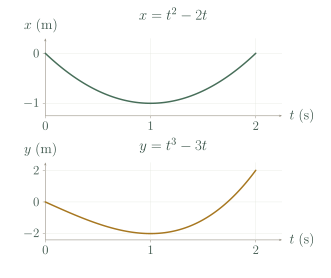
- Given velocity and acceleration , find the speed rate.2 marks
- Find speed for .2 marks
- Give an example of nonzero constant speed with zero acceleration.2 marks
Read the worked solutions
Equivalent correct methods earn the corresponding marks. Include units where asked.
- Find speed for m.2 marks
Velocity is .
Its magnitude is .
m/s. - Find velocity and acceleration at for .2 marks
Velocity is .
Acceleration is ; substitute .
and . - When is momentarily at rest?2 marks
The first velocity component vanishes only at .
The second also vanishes there.
. - Given velocity and acceleration , find the speed rate.2 marks
The dot product is .
Divide by speed ; the particle slows down.
- Find speed for .2 marks
Velocity is .
The squared speed is .
- Give an example of nonzero constant speed with zero acceleration.2 marks
Velocity is the constant vector .
Its derivative is zero.
has speed and zero acceleration.
Curriculum reference & lesson scope
SACE Stage 2 Specialist Mathematics · Topic 6
Position, velocity, acceleration and speed for motion in two and three dimensions; interpreting changes in speed.
Official SACE subject outline ↗Scope checked against subtopic 6.4 (component velocity and speed in 2D and 3D) and 6.5 (first and second derivatives in motion). The dot-product speed test is derived in this lesson from differentiation and vector magnitude. Examples and explanations are original.