
Understand the method.
A quadratic Bézier curve blends three controls. It starts at the first and ends at the last; the middle control shapes the bend.
Blend three controls to make a quadratic path
A quadratic Bézier path is a weighted combination of three control points. Evaluate the weights at the required parameter value, then combine corresponding coordinates.
For , the weights are nonnegative and sum to . The path stays in the control triangle, starts at and ends at . It generally does not pass through .
Read tangent directions from the controls
A nonzero endpoint derivative gives the oriented tangent direction. For a quadratic, the initial direction follows the first control-polygon edge; the final direction follows the last edge.
A positive scalar multiple gives the same oriented tangent direction, but it does not give the same derivative magnitude. If neighbouring controls coincide, the corresponding endpoint derivative is zero and cannot alone supply a tangent direction.
Use four controls for a cubic path
A cubic Bézier path blends four control points. Its endpoint derivatives use the first and last control edges with a factor of , instead of the quadratic factor of .
To join paths, first match their endpoint positions. Match nonzero oriented tangent directions for a common travel direction; match the complete derivative vectors when equal parameter rates are required. A dimensionless parameter derivative is not automatically a physical velocity.
See the method in action.
Evaluate a quadratic and its initial direction
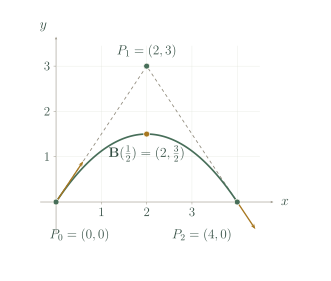
A quadratic Bézier curve has controls , and . Find and the initial tangent direction.
Worked solution
- 1
Evaluate the three weights.
The weights sum to and must be applied to the controls in their original order.
- 2
Combine the corresponding coordinates.
The curve point lies below the middle control ; the control is not a point the curve is required to visit.
- 3
Use the first control displacement.
This nonzero derivative is a positive multiple of , so both vectors give the same initial oriented tangent direction.
; the initial tangent direction is , with derivative .
Find the endpoint derivatives of a cubic
A cubic Bézier curve has controls , , and , in that order. Find its endpoint derivatives and its point at .
Worked solution
- 1
Apply the cubic initial-derivative formula.
The first control edge determines the initial direction, scaled by the cubic degree.
- 2
Apply the cubic final-derivative formula.
Subtract the penultimate control from the final control to preserve the direction of increasing parameter.
- 3
Evaluate using the midpoint weights.
The cubic weights at one half are , , and . They sum to .
, and .
Choose a control for a smooth join
A drawing path uses quadratic controls , and . A second quadratic starts at and ends at . Choose so its initial derivative equals the first curve's final derivative.
Worked solution
- 1
Find the derivative arriving at the join.
The first curve arrives in the direction from its middle control to its endpoint.
- 2
Equate the next curve's initial derivative.
Matching the entire derivative fixes both its direction and magnitude for the two curve parameters.
- 3
Solve for the middle control and verify.
The shared endpoint already matches position. This control also makes the one-sided derivative vectors equal.
Choose . The curves share and both have derivative at the join.
Try it yourself.
Calculate, explain, then apply.
Calculate a weighted point
Find for quadratic controls , and .
Show answer & reasoning
.
Use weights , , . The horizontal coordinate is and the vertical coordinate is .
Interpret the middle control
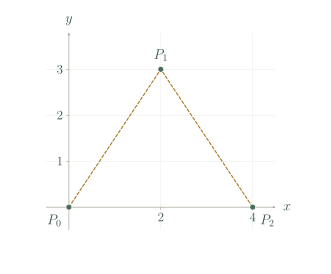
A quadratic has controls , and . A learner says the path must pass through because it is a control point. Explain the error.
Show answer & reasoning
The middle control shapes the path; it is not a required point on it. Here the curve has maximum height , below .
The vertical coordinate is , whose maximum on is at . Only the first and last controls are guaranteed endpoints.
Apply a join between different degrees
A cubic ends at with penultimate control . A quadratic begins at . Choose its next control so the endpoint derivatives match.
Show answer & reasoning
.
The arriving cubic derivative is . Set , so . The degree factors differ.
Keep practising
6 worksheet questions · 12 marks
Read the questions online
- Find endpoints for quadratic controls , , .2 marks
- Find for quadratic controls , , .2 marks
- Find endpoint derivatives for quadratic controls , , .2 marks
- Expand the quadratic rule with controls , , .2 marks
- For a cubic with , , find its initial derivative.2 marks
- Show quadratic Bézier weights sum to .2 marks
Read the worked solutions
Equivalent correct methods earn the corresponding marks. Include units where asked.
- Find endpoints for quadratic controls , , .2 marks
At only the first weight remains.
At only the last remains.
Start , end . - Find for quadratic controls , , .2 marks
Use weights , , .
The coordinates are and .
- Find endpoint derivatives for quadratic controls , , .2 marks
Compute twice each end control displacement.
and .
and . - Expand the quadratic rule with controls , , .2 marks
The coordinate is .
The coordinate is .
. - For a cubic with , , find its initial derivative.2 marks
Use .
Multiply by .
- Show quadratic Bézier weights sum to .2 marks
Expand every product.
All terms cancel, leaving .
.
Curriculum reference & lesson scope
SACE Board of South Australia
Stage 2 Specialist Mathematics school Vector calculus: polynomial and trigonometric parameterisations, related coordinate rates, Bézier paths, componentwise differentiation and integration, motion, tangent directions, circular motion and arc length. Reasoning and proofs use these school topics; vector-field calculus is outside this chapter.
Official curriculum source ↗