
Understand the method.
Displacement is final position minus initial position. Its magnitude is endpoint separation, which need not equal distance travelled.
Position locates the particle relative to an origin
A position vector lists coordinates measured from a chosen origin. In three dimensions, the coefficients of , and are the horizontal, second and third coordinates.
The magnitude is the distance from the origin at that instant. A constant third coordinate means the path remains in a plane parallel to the plane.
Subtract positions to find displacement
Displacement points from the initial position to the final position. Subtract earlier from later in every component, keeping the same coordinate order and units.
Its magnitude measures the direct endpoint separation. Changing the origin changes both position vectors by the same amount, so it does not change their difference.
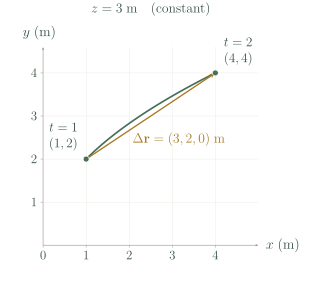
Separate travelled distance from endpoint separation
Distance travelled follows the actual route. It is at least the endpoint separation, and is greater if the route curves or doubles back. Returning to the start gives zero displacement after a nonzero journey.
Keep the meaning of the parameter explicit. If is seconds and positions are metres, derivatives have units m/s. A derivative with respect to a dimensionless curve parameter is not automatically a physical velocity.
See the method in action.
Evaluate positions and subtract in three dimensions
For metres with in seconds, find the position at , the displacement from to , and its magnitude.
Worked solution
- 1
Evaluate the complete position at both times.
The constant third coordinate stays equal to metres; it is not removed when evaluating a position.
- 2
Subtract the initial position from the final position.
The zero third displacement means there is no change in that coordinate, even though its position coordinate is nonzero.
- 3
Take the magnitude of the displacement.
This is the separation of the two positions. By comparison, metres is the final distance from the origin.
Position metres; displacement metres; endpoint separation metres.
Return to the start after a nonzero journey
A particle has position metres for seconds. Find its displacement, endpoint separation and distance travelled.
Worked solution
- 1
Evaluate the two endpoint positions.
The sine and cosine values repeat after a full revolution.
- 2
Find the displacement and its magnitude.
The endpoints coincide, so both the displacement vector and the endpoint separation are zero.
- 3
Identify the actual route.
As increases from to , the particle makes one complete circuit of the unit circle, whose circumference is metres.
Displacement metres; endpoint separation metres; distance travelled metres.
Describe the same drone journey from a new origin
A drone follows metres for seconds. Find its displacement. A new origin is at old coordinates metres; show that the displacement is unchanged.
Worked solution
- 1
Evaluate positions and subtract.
The displacement measures the change between positions rather than either position on its own.
- 2
Subtract the new origin coordinates from both positions.
Write for position relative to the new origin. Its coordinates are the old coordinates minus the position of that origin.
- 3
Compare the new displacement and separation.
The same origin shift cancels in the subtraction. Here the constant coordinate rates give a straight journey, so its travelled distance also equals metres.
The displacement is metres in both coordinate systems. Its magnitude is metres.
Try it yourself.
Calculate, explain, then apply.
Calculate a displacement
Find the displacement from to for metres.
Show answer & reasoning
metres.
The positions are and . Final minus initial gives .
Interpret a position magnitude
A particle is at metres. A learner says it has therefore travelled metres. What does the value actually measure, and what information is missing?
Show answer & reasoning
It is metres from the chosen origin. Its travelled distance needs the starting point and route.
is the magnitude of the current position vector. The particle could have started elsewhere or taken a longer route to this position.
Apply displacement to a survey route
A survey robot travels along straight segments from to and then to metres. Find its displacement, endpoint separation and total distance travelled.
Show answer & reasoning
Displacement metres; separation metres; distance travelled metres.
Subtract the initial position from the final position for displacement. Each segment has length metres, so the actual route is metres long.
Keep practising
6 worksheet questions · 12 marks
Read the questions online
- Evaluate for .2 marks
- Find displacement from to for .2 marks
- Find distance from the origin for .2 marks
- Find endpoint separation between and .2 marks
- Identify the Cartesian path of .2 marks
- Give a position function for the line through with direction .2 marks
Read the worked solutions
Equivalent correct methods earn the corresponding marks. Include units where asked.
- Evaluate for .2 marks
Substitute into each coordinate.
The third coordinate stays .
- Find displacement from to for .2 marks
The initial vector is zero.
The final vector is .
- Find distance from the origin for .2 marks
Magnitude squared is .
This equals .
- Find endpoint separation between and .2 marks
The displacement is .
Its magnitude is .
units. - Identify the Cartesian path of .2 marks
.
Substitute into .
. - Give a position function for the line through with direction .2 marks
At zero the given point is obtained.
The parameter moves along the required direction.
.
Curriculum reference & lesson scope
SACE Board of South Australia
Stage 2 Specialist Mathematics school Vector calculus: polynomial and trigonometric parameterisations, related coordinate rates, Bézier paths, componentwise differentiation and integration, motion, tangent directions, circular motion and arc length. Reasoning and proofs use these school topics; vector-field calculus is outside this chapter.
Official curriculum source ↗