
Understand the method.
Cartesian form gives coordinates. Polar form gives modulus and argument .
Two descriptions of one point
On an Argand diagram, is the horizontal real coordinate and is the vertical imaginary coordinate. The modulus is the distance from the origin.
The argument is measured anticlockwise from the positive real axis. Here angles are in radians. The abbreviation means .
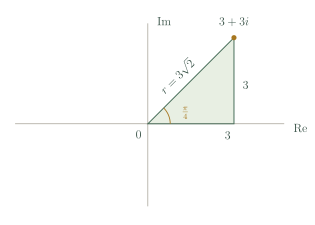
Locate the point before choosing its angle
Use Pythagoras for the modulus. For a nonzero real coordinate, , but a tangent ratio alone cannot distinguish opposite quadrants.
Find a reference angle, then use the signs of and to select the correct quadrant.
Keep the direction meaningful
Angles differing by a whole turn give the same point. State an argument in the interval requested by the question.
The number zero has no defined argument. Its modulus is zero, so every direction reaches the same point.
See the method in action.
Convert a second-quadrant point
Write in polar form.
Worked solution
- 1
Find the modulus.
The modulus is a nonnegative distance.
- 2
Locate the quadrant and reference angle.
The point lies in quadrant II. Its reference triangle has side lengths , and .
- 3
Choose the argument and write polar form.
The angle is measured from the positive real axis, not from the negative one.
.
Recover exact coordinates
Write in Cartesian form.
Worked solution
- 1
Calculate the real coordinate.
Cosine gives the horizontal component.
- 2
Calculate the imaginary coordinate.
The negative angle lies below the real axis, so this coordinate is negative.
- 3
Combine the coordinates.
Keep with the imaginary component, not with the modulus.
.
Try it yourself.
Calculate, explain, then apply.
Read an argument from an axis
Give a polar form of .
Show answer & reasoning
.
The point is units below the origin: modulus and argument .
Keep practising
6 worksheet questions · 13 marks
Read the questions online
- Convert to polar form.2 marks
- Convert to polar form with .2 marks
- Convert to Cartesian form.2 marks
- A signal is represented by . State its real and imaginary components.2 marks
- A student writes . Explain and correct the error.3 marks
- Why is an argument of undefined?2 marks
Read the worked solutions
Equivalent correct methods earn the corresponding marks. Include units where asked.
- Convert to polar form.2 marks
and the equal positive coordinates give .
. - Convert to polar form with .2 marks
The modulus is . Quadrant III has principal angle .
. - Convert to Cartesian form.2 marks
Multiply 6 by and .
. - A signal is represented by . State its real and imaginary components.2 marks
and .
Real component ; imaginary component . - A student writes . Explain and correct the error.3 marks
The given angle produces a positive real part and a negative imaginary part, opposite to those required.
The angle is in the wrong quadrant; use . - Why is an argument of undefined?2 marks
Every value of gives , so no direction is distinguished.
Zero has no direction from the origin.
Curriculum reference & lesson scope
SACE Board of South Australia
Stage 2 Specialist Mathematics complex numbers: Cartesian and polar representations, de Moivre, roots and roots of unity, Argand geometry and loci, complex factorisation and conjugate roots of real polynomials. Real-polynomial techniques are taught in the separate Real Polynomials chapter.
Official curriculum source ↗