
Understand the idea.
Set the region up first
For a region between two curves, a vertical strip has height upper minus lower. Solve for intersections, inspect the order between them, and integrate that height over the required interval. The strip height must remain nonnegative.
Split the integral wherever the curves switch order. For area between one curve and the axis, split at its zeros and choose the positive height on each subinterval. Sketch the boundaries so that the integral covers exactly the requested region.
Respect the chosen variable
A horizontal strip instead has width right boundary minus left boundary and thickness . Express both boundaries as functions of and find the corresponding vertical limits. This can avoid several pieces when vertical slicing would be awkward.
Area has square units because strip height and thickness both measure length. If an unsplit calculation gives zero for a visible region, check for cancellation: signed integral and total geometric area answer different questions.
See the method in action.
Worked example 1
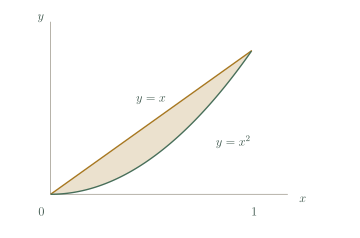
Find the area between y=x and y=x squared from x=0 to 1.
Worked solution
- 1
Find the intersections and order.
Between zero and one, x is at least x squared, so the line is the upper curve.
- 2
Integrate the positive strip height.
A vertical strip extends from the parabola to the line.
- 3
Evaluate the area.
The difference is positive and uses square units, as a geometric area requires.
square units
Worked example 2
Find total area between y=x squared-1 and the x axis from -2 to 2.
Worked solution
- 1
Find zeros and use symmetry.
The function is even; it lies below the axis between the roots and above it outside them.
- 2
Write nonnegative heights on the positive half.
Reflection doubles the right-hand area, with the sign reversed only where the curve lies below the axis.
- 3
Evaluate both pieces.
Each expression integrates the positive distance from the curve to the axis.
- 4
Add the geometric areas.
All four symmetric portions contribute positively to total area.
square units
Try it yourself.
Check your understanding
What are the intersection x values for x squared=2x?
Show answer & reasoning
0 and 2.
Rearrange as . A product is zero when at least one factor is zero, giving intersection inputs and .
Keep practising
6 worksheet questions · 12 marks
Read the questions online
- Find the area between and .2 marks
- Find the area under above the axis.2 marks
- Find the area between and the axis on .2 marks
- Find the area between and on .2 marks
- Find area between and for .2 marks
- A student reports area zero between and the axis on . Correct the result.2 marks
Read the worked solutions
Equivalent correct methods earn the corresponding marks. Include units where asked.
- Find the area between and .2 marks
The intersections are 0 and 2.
Integrate over that interval.
square units - Find the area under above the axis.2 marks
Zeros are -2 and 2.
Integrate between them.
square units - Find the area between and the axis on .2 marks
Use two congruent right triangles.
Each has area .
square unit - Find the area between and on .2 marks
is at least throughout this interval.
Integrate and evaluate endpoints.
square units - Find area between and for .2 marks
Horizontal slices have width .
Integrate from to 2.
square units - A student reports area zero between and the axis on . Correct the result.2 marks
The signed integral is zero, but areas add.
Use twice the integral of from 0 to 1.
square unit
Curriculum reference & lesson scope
SACE Board of South Australia
Stage 2 Specialist Mathematics integration techniques and applications, including inverse-trigonometric patterns, substitution, parts, simple partial fractions, areas and solids of revolution.
Official curriculum source ↗