
Understand the idea.
Reciprocate ordinates
For , keep each allowed input and reciprocate its nonzero output. Signs are preserved. Large output magnitudes become small, while outputs close to zero create large reciprocal magnitudes. Ordinates and stay fixed.
Every zero of is excluded from the reciprocal domain. When approaches zero there, investigate the one-sided reciprocal behaviour to identify a vertical asymptote. Use the formula and domain rather than drawing through the excluded input.
Use exact transformations
For with , the vertical and horizontal asymptotes are and . Their intersection is the centre of symmetry; the sign of determines the branch orientation.
Where is differentiable and nonzero, the reciprocal derivative is . Its denominator is positive, so its sign is opposite to that of . Separate derivative intervals at poles as well as stationary inputs.
See the method in action.
The reciprocal of a quadratic
For , identify vertical asymptotes, intercepts and the stationary point of .
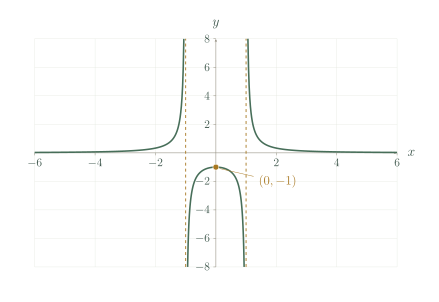
Worked solution
- 1
Find the domain and vertical asymptotes.
The numerator is nonzero at both denominator zeros, so and are vertical asymptotes.
- 2
Determine the intercepts.
The vertical intercept is and the nonzero numerator prevents horizontal intercepts.
- 3
Differentiate and solve for a stationary input.
Only the numerator can be zero on the domain.
- 4
Classify the stationary point.
The central branch increases then decreases, so is a local maximum, not a global maximum across the poles.
Vertical asymptotes ; y-intercept and local maximum ; no x-intercepts.
A translated reciprocal
For , state its asymptotes, intercepts and centre of symmetry.
Worked solution
- 1
Read the translated asymptotes.
The denominator vanishes at one, and the reciprocal term tends to zero as grows.
- 2
Solve for the horizontal intercept.
Multiplication by is valid at this allowed solution, giving .
- 3
Find the vertical intercept.
The graph meets the vertical axis at .
- 4
State the centre of symmetry.
In shifted coordinates and , the equation is unchanged by .
, ; x-intercept , y-intercept ; centre .
Try it yourself.
Check your understanding
What happens to an ordinate of -5 after reciprocation?
Show answer & reasoning
.
The reciprocal of is . The result stays negative because the denominator is negative.
Keep practising
6 worksheet questions · 19 marks
Read the questions online
- For , identify vertical asymptotes, intercepts and the stationary point of .4 marks
- Find the range and asymptote of .3 marks
- Which points on a graph remain fixed when changing to ?3 marks
- For , state its asymptotes, intercepts and centre of symmetry.4 marks
- Find the domain of and explain the endpoint.3 marks
- If , find the corresponding ordinate on . Does its sign change?2 marks
Read the worked solutions
Equivalent correct methods earn the corresponding marks. Include units where asked.
- For , identify vertical asymptotes, intercepts and the stationary point of .4 marks
.
, positive before 0 and negative after 0 within the central branch.
Vertical asymptotes ; y-intercept and local maximum ; no x-intercepts. - Find the range and asymptote of .3 marks
The denominator is at least 1 and grows without bound.
The maximum 1 occurs at ; zero is approached but never reached.
Range ; horizontal asymptote . - Which points on a graph remain fixed when changing to ?3 marks
Solve , with nonzero.
This gives .
Points where or . - For , state its asymptotes, intercepts and centre of symmetry.4 marks
For , solve .
Substitute for the y-intercept.
, ; x-intercept , y-intercept ; centre . - Find the domain of and explain the endpoint.3 marks
The square root needs nonnegative.
The reciprocal also excludes .
. - If , find the corresponding ordinate on . Does its sign change?2 marks
Reciprocation preserves the sign of a nonzero real number.
; the sign stays negative.
Curriculum reference & lesson scope
SACE Board of South Australia
Stage 2 Specialist functions and sketching graphs. Calculus-based analysis assumes concurrent Methods differentiation; real-polynomial division detail is taught in the separate Real Polynomials chapter.
Official curriculum source ↗