
Understand the method.
Initial position plus elapsed time times constant velocity. A collision requires equal positions at one common admissible time.
Constant coordinate rates give a straight path
With constant velocity, each coordinate changes by a fixed amount per unit time. The initial position gives the constant terms; the velocity gives the coefficients of time.
A positive component means that coordinate increases; a negative component means it decreases. Restrict time to the interval for which the model applies.
Separate speed from displacement
Speed is the magnitude of velocity, so it is nonnegative. Add the squared perpendicular components before taking a square root; adding signed components does not give speed.
Displacement over an interval is velocity multiplied by elapsed time. For constant velocity, distance travelled is speed multiplied by elapsed time.
A collision needs one common time
For a collision, both objects must have the same coordinates at the same time. Equate their positions using a common clock, and check every coordinate at the candidate time.
Separate parameters can locate a geometric intersection of paths. Compare the arrival times before concluding that the objects collide. Check that each time is in the stated interval.
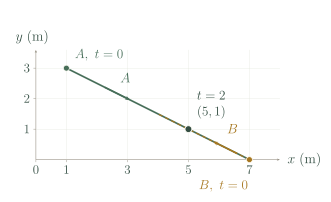
See the method in action.
Find speed and displacement
A particle has position metres, with in seconds. Find its velocity, speed, displacement and distance travelled from to .
Worked solution
- 1
Read the coordinate rates.
The horizontal coordinate increases by metres each second and the vertical coordinate decreases by metres each second.
- 2
Take the magnitude to find speed.
The negative vertical component describes direction; its square contributes positively to speed.
- 3
Use the elapsed time for both travel quantities.
Displacement is a vector. Distance is a nonnegative scalar, and the straight path makes it equal to the displacement magnitude.
Velocity m/s; speed m/s; displacement m; distance travelled m.
Verify a collision in both coordinates
Two particles have positions and metres for seconds. Do they collide?
Worked solution
- 1
Equate the horizontal coordinates.
Any collision must have this time because the horizontal coordinates must match.
- 2
Check the vertical coordinates at that same time.
Both coordinates match at the same admissible time, not merely at two separate times.
- 3
Find the common position.
Substitution into both position rules confirms the collision point.
They collide at seconds, at metres.
Distinguish crossing tracks from a collision
Two carts have positions and metres for seconds. Their paths cross at . Do they collide?
Worked solution
- 1
Find when the first cart reaches the crossing.
The first cart moves along the horizontal axis and reaches the crossing after seconds.
- 2
Find when the second cart reaches the crossing.
The second cart has constant horizontal coordinate and reaches vertical coordinate after second.
- 3
Check the same-time requirement directly.
Matching horizontal coordinates forces , but the vertical coordinates differ then. There is no other candidate time.
No collision. Cart reaches at second and cart reaches it at seconds.
Try it yourself.
Calculate, explain, then apply.
Calculate velocity and speed
For metres with in seconds, find velocity and speed.
Show answer & reasoning
m/s and speed m/s.
The coefficients of are the coordinate rates. Speed is , not the signed sum .
Interpret different arrival times
Cart has position and cart has position metres for seconds. Both tracks contain . Does this prove a collision?
Show answer & reasoning
No. Cart arrives at seconds and cart at seconds.
At the only candidate common time , cart is at . A geometric crossing is insufficient without a common arrival time.
Apply a meeting model
Two automated vehicles use the same clock. Their positions are and metres for seconds. Decide whether they meet and give the meeting position.
Show answer & reasoning
They meet at seconds at metres.
The horizontal equation gives . The vertical coordinates are then and , and the time is within the model interval.
Keep practising
6 worksheet questions · 12 marks
Read the questions online
- Write position from initial m and velocity m/s.2 marks
- Find speed for m.2 marks
- A is at and B at . Find collision time.2 marks
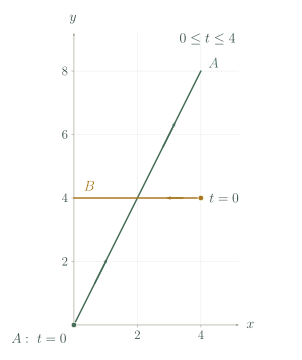
- A is at and B at . Do they collide?2 marks
- A particle moves from to in s. Find constant velocity.2 marks
- Find distance travelled by on .2 marks
Read the worked solutions
Equivalent correct methods earn the corresponding marks. Include units where asked.
- Write position from initial m and velocity m/s.2 marks
Use initial position plus times velocity.
Check at .
m. - Find speed for m.2 marks
Velocity is .
Speed is .
m/s. - A is at and B at . Find collision time.2 marks
Equate to get .
Both coordinates then equal .
, at . - A is at and B at . Do they collide?2 marks
Equal requires .
At , their values are and .
No. - A particle moves from to in s. Find constant velocity.2 marks
Displacement is .
Divide by .
units/s. - Find distance travelled by on .2 marks
Constant speed is .
Multiply by elapsed time .
units.
Curriculum reference & lesson scope
SACE Board of South Australia
Stage 2 Specialist Mathematics school Vector calculus: polynomial and trigonometric parameterisations, related coordinate rates, Bézier paths, componentwise differentiation and integration, motion, tangent directions, circular motion and arc length. Reasoning and proofs use these school topics; vector-field calculus is outside this chapter.
Official curriculum source ↗