
Understand the method.
One parameter value gives one complete point. Keep its interval and increasing-parameter direction with the path.
One parameter chooses both coordinates
A parametric description gives the coordinates as functions of the same parameter. Substitute one value of into both functions to find a point; do not mix coordinates from different values.
The parameter may be time, but it can also be a dimensionless way of moving along a curve. Plot a few values in increasing parameter order to establish the direction. A vertical line is valid too: , fixes one coordinate while the other varies, even though it is not a function .
Eliminate the parameter, then keep its restrictions
Eliminate the parameter by expressing it using one coordinate and substituting into the other equation. This finds a Cartesian relationship between the coordinates.
A Cartesian equation can include more points than the parameter interval permits. Keep the traced portion and check any branches introduced by squaring or taking square roots.
Keep the information the Cartesian equation loses
Use the parameter endpoints to locate the start and finish. Intermediate values reveal turns and repeated visits that the Cartesian equation alone cannot show.
To parameterise a directed segment, start at and add a fraction of its displacement towards . Restrict that fraction to .
See the method in action.
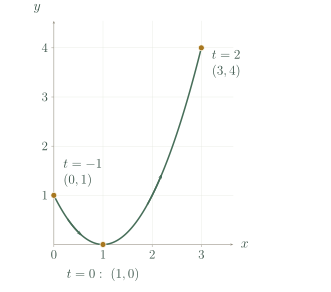
Describe the part of a parabola that is traced
For , and , find the Cartesian equation, traced portion and direction.
Worked solution
- 1
Solve the first equation for the parameter.
This expression can replace every occurrence of in the other coordinate.
- 2
Substitute into the second equation.
Every point generated by the parameter satisfies this Cartesian equation.
- 3
Evaluate endpoints and one intermediate point.
The coordinate increases throughout the interval, so and the curve is traced left to right.
, restricted to , from through to .
Build a directed segment
Parameterise the segment from to , starting at when and finishing at when .
Worked solution
- 1
Find the displacement from the start to the finish.
Subtract the starting coordinates from the finishing coordinates in the same order.
- 2
Add a parameter multiple to the starting point.
As increases from to , the multiple of the displacement increases from none to all of it.
- 3
Check both endpoint values.
The interval is essential: unrestricted real values would describe the whole line.
, , with .
Read an outward and return journey
A small robot has coordinates , metres for seconds. Describe the path and explain why does not tell the whole story.
Worked solution
- 1
Compare the coordinate formulas.
The squared quantity lies between and , so the geometric path is a segment of the diagonal line.
- 2
Evaluate the start, middle and finish.
The squared quantity decreases until and then increases. The order shows the reversal.
- 3
Compare the parametric and Cartesian information.
The robot returns to its initial position after tracing the same segment in opposite directions. The equation records neither the reversal nor the timing.
It moves from to during the first second, then returns to during the second. The segment is traced twice.
Try it yourself.
Calculate, explain, then apply.
Calculate a Cartesian equation
Eliminate from and , where is real.
Show answer & reasoning
.
Solve , then substitute into . Both coordinates must use the same value of .
Interpret the traced portion
For , and , is the whole traced curve? Give the correct relationship and direction.
Show answer & reasoning
No. with , traced from through to .
Negative parameter values give negative . Selecting only the positive square root discards half the path; the parameter order also identifies its orientation.
Apply a timed segment model
A camera moves at constant coordinate rates from metres at to metres at seconds. Give its parametric equations and time interval.
Show answer & reasoning
, , for .
The displacement is metres over seconds, so the coordinate rates are m/s. Substituting and verifies both endpoints.
Keep practising
6 worksheet questions · 12 marks
Read the questions online
- Find the point at for , .2 marks
- Eliminate from , .2 marks
- For , , , give the Cartesian equation and restriction.2 marks
- Parameterise the segment from to .2 marks
- For , , , find the start and end points.2 marks
- Explain the repeated trace for , , .2 marks
Read the worked solutions
Equivalent correct methods earn the corresponding marks. Include units where asked.
- Find the point at for , .2 marks
Substitute into both coordinates.
, .
- Eliminate from , .2 marks
.
Substitute into .
- For , , , give the Cartesian equation and restriction.2 marks
Use .
The parameter restriction selects the upper branch.
, . - Parameterise the segment from to .2 marks
The displacement is .
Add its multiple to the starting point.
, , . - For , , , find the start and end points.2 marks
Evaluate the two endpoints.
.
From to , moving left. - Explain the repeated trace for , , .2 marks
Opposite values have equal squares.
The Cartesian equation does not show the reversal.
It travels from to , then back to .
Curriculum reference & lesson scope
SACE Board of South Australia
Stage 2 Specialist Mathematics school Vector calculus: polynomial and trigonometric parameterisations, related coordinate rates, Bézier paths, componentwise differentiation and integration, motion, tangent directions, circular motion and arc length. Reasoning and proofs use these school topics; vector-field calculus is outside this chapter.
Official curriculum source ↗