
Understand the method.
For and nonzero constant , the path is a radius- circle centred at . One revolution takes time units.
Separate the path from its timing
For , , with and , subtract the centre coordinates, divide by the amplitudes, square and add. The result is an ellipse; equal amplitudes give a circle.
The Cartesian equation identifies the path, but it does not say how quickly or in which direction the object moves. Use the parameter functions for that information.
Read the angular rate and the motion
One turn changes the angle by . With constant nonzero angular rate , the period is . Check the starting point and velocity to establish direction; changing one sine sign reverses the orientation.
On a circle, speed is and acceleration points inward, with magnitude . A shifted circle uses position relative to its centre .
Check speed instead of assuming it
An ellipse with unequal amplitudes generally has variable speed: its squared velocity components do not combine to one constant. Differentiate and calculate the magnitude.
A helix adds a constant vertical rate: . Its horizontal and vertical velocity components are perpendicular, so combine their magnitudes using Pythagoras. Its vertical change per turn is , which can be positive or negative.
See the method in action.
Describe a circular route
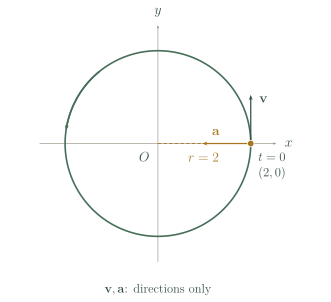
A particle has position metres, with in seconds. Find its radius, period, speed and acceleration magnitude. State its direction from .
Worked solution
- 1
Identify the radius and angular rate.
Equal amplitudes give a circle centred at the origin. The angle increases by radians each second.
- 2
Find the time for one revolution.
s.A complete revolution corresponds to an angular increase of .
- 3
Differentiate and calculate the magnitudes.
The trigonometric identity makes both magnitudes constant. Speed is in m/s and acceleration magnitude is in m/s².
- 4
Inspect the starting point and velocity.
At the rightmost point, upward velocity means counterclockwise motion. The acceleration points toward the centre.
Radius m, period s, speed m/s, and acceleration magnitude m/s². Motion is counterclockwise from .
Test the speed around an ellipse
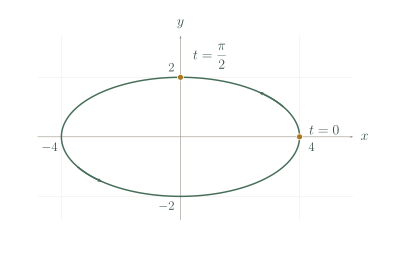
For metres, find the Cartesian path and compare the speeds at and seconds. Is the speed constant?
Worked solution
- 1
Divide by the amplitudes, square and add.
The unequal semiaxes m and m give an ellipse.
- 2
Differentiate before taking magnitudes.
The coefficients and differ, so the trigonometric identity does not turn this expression into one constant.
- 3
Compare two times on the same route.
Two different speed values prove that speed is not constant, even though the angular parameter increases uniformly.
The path is . The speeds are m/s and m/s, so the speed is not constant.
Combine rotation with a steady climb
An inspection drone follows metres for one revolution, starting at . Find its speed, the time for one turn, and its rise, with in seconds.
Worked solution
- 1
Differentiate all three coordinates.
The drone combines circular horizontal motion with a constant vertical velocity of m/s.
- 2
Combine the squared velocity components.
The horizontal speed is m/s. The perpendicular vertical rate is m/s, giving total speed m/s.
- 3
Use the horizontal angle to time one turn.
s, m.The horizontal angle is , so one revolution lasts seconds. The height increases throughout that time.
Speed m/s; one turn takes s and rises m. The horizontal coordinates return to their start, but the drone is higher.
Try it yourself.
Calculate, explain, then apply.
Read a shifted circular model
For metres, find its centre, radius, period, speed and acceleration magnitude. Time is in seconds.
Show answer & reasoning
Centre m; radius m; period s; speed m/s; acceleration magnitude m/s².
The constants shift the centre and do not change velocity. With and , use , and .
Use velocity to decide direction
A particle follows metres. At , does it move clockwise or counterclockwise? Does changing the sine sign change its speed?
Show answer & reasoning
It moves clockwise, initially downward from . Its speed remains m/s.
The derivative is , giving at zero. This is downward at the rightmost point. Squaring the components removes the changed sign, leaving speed .
Plan a rising scanner’s first turn
A scanner moves along metres. How long does its first full turn take, how far does it rise, and what is its speed? Time is in seconds.
Show answer & reasoning
One turn takes s, rises m, and has speed m/s.
The angle is , so gives . The height change is . Velocity is , so speed is .
Keep practising
6 worksheet questions · 12 marks
Read the questions online
- Find the Cartesian locus of .2 marks
- Find speed and acceleration magnitude for .2 marks
- At , describe direction for .2 marks
- Find centre and radius of .2 marks
- Find speed for .2 marks
- Compare speeds at and for .2 marks
Read the worked solutions
Equivalent correct methods earn the corresponding marks. Include units where asked.
- Find the Cartesian locus of .2 marks
Divide by the amplitudes, square and add.
Use the Pythagorean trig identity.
. - Find speed and acceleration magnitude for .2 marks
Use radius times angular speed for speed.
Use radius times angular speed squared for acceleration.
and . - At , describe direction for .2 marks
The derivative at zero is .
That is downward at the rightmost point.
Down from , clockwise. - Find centre and radius of .2 marks
The constants shift the centre.
The equal amplitudes give the radius.
Centre , radius . - Find speed for .2 marks
Velocity is .
Squared speed is .
- Compare speeds at and for .2 marks
Velocity is .
The specified times give and .
and .
Curriculum reference & lesson scope
SACE Board of South Australia
Stage 2 Specialist Mathematics school Vector calculus: polynomial and trigonometric parameterisations, related coordinate rates, Bézier paths, componentwise differentiation and integration, motion, tangent directions, circular motion and arc length. Reasoning and proofs use these school topics; vector-field calculus is outside this chapter.
Official curriculum source ↗