
Understand the idea.
Two pieces of information
An enlargement is specified by a centre and a scale factor. For a positive factor , each image point lies on the ray from the centre through its original point, with its distance from the centre multiplied by .
With centre at the origin, this becomes . A positive factor greater than one increases lengths; a factor between zero and one reduces them. The centre stays fixed, and leaves every point unchanged.
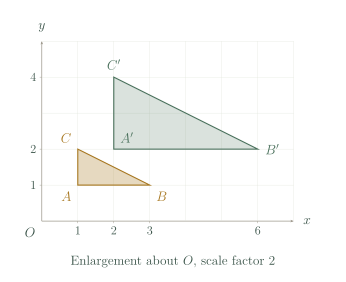
A centre away from the origin
For another centre, scale the displacement rather than the coordinates. Subtract the centre coordinates from the point, multiply the resulting pair by , then add the centre back. This keeps the centre fixed throughout the transformation.
Positive enlargement preserves angles and shape, while multiplying corresponding lengths and perimeter by . Adding the same coordinate pair to every point instead produces a translation: it moves a figure without changing its size.
See the method in action.
Origin-centred enlargement
Enlarge by scale factor 2 about the origin.
Worked solution
- 1
Use the origin-centred coordinate rule.
The scale factor is two and the centre is the origin.
- 2
Double both signed coordinates.
Scaling a displacement doubles each component while preserving its sign.
- 3
Write the image point.
The image lies twice as far along the ray from the origin through P.
Use a different centre
Enlarge by scale factor 2 about .
Worked solution
- 1
Find the displacement from C to P.
Enlargement measures positions relative to its centre.
- 2
Double this displacement.
The scale factor applies to the displacement, not directly to the original coordinates.
- 3
Return to coordinates measured from the origin.
Adding the centre places the scaled displacement back at C.
Try it yourself.
Check your understanding
Reduce by scale factor about the origin.
Show answer & reasoning
The centre is the origin, so halve each coordinate: . The image is halfway from the origin to A.
Keep practising
6 worksheet questions · 14 marks
Read the questions online
- Enlarge by factor 3 about the origin.2 marks
- Reduce by factor about the origin.2 marks
- For an origin-centred enlargement, maps to . Find the scale factor.2 marks
- A shape has perimeter 18 cm. It is enlarged by factor 1.5. Find its new perimeter.2 marks
- Find the image of under factor 3 about .3 marks
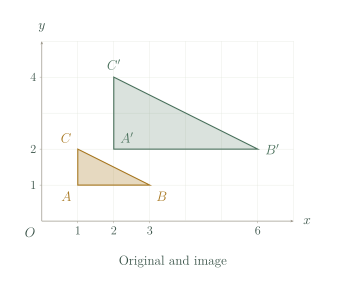
- In the supplied diagram, name the centre and scale factor taking to its image.3 marks
Read the worked solutions
Equivalent correct methods earn the corresponding marks. Include units where asked.
- Enlarge by factor 3 about the origin.2 marks
.
- Reduce by factor about the origin.2 marks
.
- For an origin-centred enlargement, maps to . Find the scale factor.2 marks
and .
- A shape has perimeter 18 cm. It is enlarged by factor 1.5. Find its new perimeter.2 marks
Every side is multiplied by 1.5, so perimeter cm.
cm - Find the image of under factor 3 about .3 marks
Displacement is .
Scaled displacement is .
Add to get .
- In the supplied diagram, name the centre and scale factor taking to its image.3 marks
Each image point lies on the same ray from as its original.
Both coordinates and each distance from are doubled.
Centre , scale factor 2.
Curriculum reference & lesson scope
Australian Curriculum v9 and SA Curriculum Mathematics
Year 9 proportional modelling, rates, scale, similarity and enlargement. Assumptions, interpretation and model limitations are taught alongside calculation.
Official curriculum source ↗