
Understand the idea.
A root is where the output is zero
A graphical solution is an input where two plotted outputs agree. For , intersect with , or find the zeros of . The solutions are the intersections' horizontal coordinates.
A graph gives estimates whose accuracy depends on its scale. Use a table or calculator to refine them, and write for rounded values. Inspect the full stated domain so a second intersection is not missed.
Bracket and improve an estimate
To bracket a root, find inputs on either side with outputs of opposite signs. A continuous polynomial cannot move from a negative output to a positive one without passing through zero somewhere between them.
Test inside the interval and retain a smaller sign-changing interval. Continue until every value within the bracket rounds to the same required answer. Check other intervals too: a sign change locates a root, but does not automatically list all roots.
See the method in action.
Worked example
Estimate both solutions of to two decimal places.
Worked solution
- 1
Locate the positive root roughly.
The positive solution lies between 2 and 3; the upward parabola also has a negative solution.
- 2
Test close decimal bounds.
Continuity and increasing squares for positive inputs bracket the positive root.
- 3
Round the bracketed root.
Every number in this interval rounds to 2.24 at two decimal places.
- 4
Include the symmetric solution.
Squaring a number and its negative gives the same result, so both branches are required.
or
Worked example
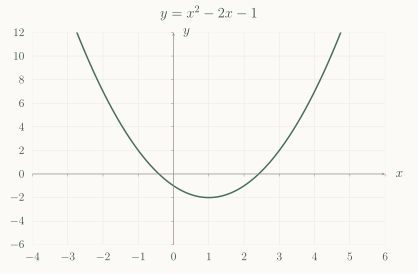
Use substitution to locate the positive root of between two consecutive tenths.
Worked solution
- 1
Evaluate at the lower tenth.
This input gives a negative output.
- 2
Evaluate at the next tenth.
This input gives a positive output.
- 3
State the root interval.
The polynomial is continuous and changes sign between these consecutive tenths.
- 4
Confirm which root is being located.
This parabola increases to the right of its axis x equal to 1, so the bracket identifies its unique positive root.
Between and .
Try it yourself.
Check your understanding
For , and . Where is a positive root?
Show answer & reasoning
Between and .
The polynomial is continuous, and . It must cross zero for some input strictly between and ; these non-zero endpoint values exclude the endpoints.
Keep practising
6 worksheet questions · 14 marks
Read the questions online
- Use a calculator to estimate both roots of to one decimal place.2 marks
- For , calculate and .2 marks
- Explain what the previous outputs show about a root of .2 marks
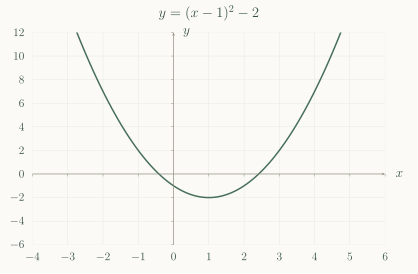
- The graph of is supplied. Estimate its roots to the nearest half unit.2 marks
- Use a table to locate the positive root of between consecutive tenths.3 marks
- Why does finding not fully solve over the real numbers?3 marks
Read the worked solutions
Equivalent correct methods earn the corresponding marks. Include units where asked.
- Use a calculator to estimate both roots of to one decimal place.2 marks
, which rounds to .
- For , calculate and .2 marks
.
.
and - Explain what the previous outputs show about a root of .2 marks
The continuous quadratic changes from negative to positive.
A positive root lies between and . - The graph of is supplied. Estimate its roots to the nearest half unit.2 marks
The actual crossings are near and .
The nearest half-unit readings are and .
About and . - Use a table to locate the positive root of between consecutive tenths.3 marks
and .
Between and . - Why does finding not fully solve over the real numbers?3 marks
Both a positive and its negative have the same square.
Check both sides of the parabola.
There is also .
Curriculum reference & lesson scope
Australian Curriculum v9 / SA Curriculum Mathematics
AC9M9A02, AC9M9A04–A06: monic quadratic expressions, integer-root equations, graphs and models.
Official curriculum source ↗