
Understand the idea.
Scale from the centre
An enlargement scales distances from a fixed centre. For positive factor , the centre, original point and image lie on one ray, with the image distance equal to times the original distance.
From the origin, scale both coordinates: . A factor above enlarges; a factor between and reduces. Negative coordinates retain their signs when multiplied by a positive factor.
Use a different centre
For another centre , use the displacement from to the point . Subtract the centre coordinates, multiply that displacement by , then add the centre back: .
Check that the original and image align with the centre and have the correct distance ratio. A digital plot can reveal an error, but the coordinate calculation records the centre and scale factor that actually define the enlargement.
See the method in action.
Enlarge a triangle
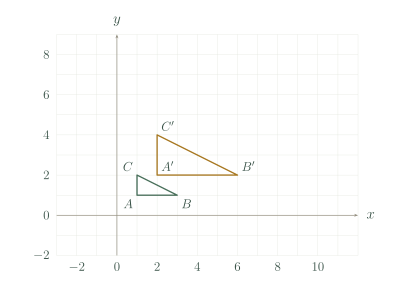
Enlarge A(1,1), B(3,1), C(1,2) by factor 2 from the origin.
Worked solution
- 1
State the coordinate rule.
The centre is the origin and the scale factor is .
- 2
Transform the first vertex.
Both coordinate displacements from the origin double.
- 3
Transform the remaining vertices.
The same scale factor applies to every vertex.
- 4
Check two corresponding lengths.
Both the horizontal and vertical sides have doubled, consistent with the enlargement.
A′(2,2), B′(6,2), C′(2,4).
A shifted centre
Enlarge P(3,2) by factor 3 from C(1,1).
Worked solution
- 1
Find the displacement from the centre.
The distance must be scaled relative to , rather than the origin.
- 2
Scale that displacement.
An enlargement by factor triples each displacement component.
- 3
Add the centre back.
Adding converts the scaled displacement into the image coordinates.
- 4
Check alignment and the scale factor.
The image displacement is a positive triple of the original, so it lies on the same ray at three times the distance.
P′(7,4).
Try it yourself.
Check your understanding
Enlarge (−4,6) by factor 1/2 from the origin.
Show answer & reasoning
(−2,3)
Multiply both coordinates by : . The positive factor halves both distances without reversing their signs.
Keep practising
6 worksheet questions · 15 marks
Read the questions online
- Enlarge by factor 2 from the origin.2 marks
- Enlarge by factor from the origin.2 marks
- Enlarge , , by factor 3 from the origin.3 marks
- Centre is . Enlarge by factor 2.3 marks
- An enlargement from the origin maps to . Find .2 marks
- A student maps to and calls it factor 2 from the origin. Give the correct image and describe the student’s movement.3 marks
Read the worked solutions
Equivalent correct methods earn the corresponding marks. Include units where asked.
- Enlarge by factor 2 from the origin.2 marks
; .
. - Enlarge by factor from the origin.2 marks
Halve both coordinates.
. - Enlarge , , by factor 3 from the origin.3 marks
Multiply every coordinate by 3.
Both perpendicular sides triple.
, , . - Centre is . Enlarge by factor 2.3 marks
.
Double to , then add to get .
. - An enlargement from the origin maps to . Find .2 marks
and . Both coordinates give the same factor.
- A student maps to and calls it factor 2 from the origin. Give the correct image and describe the student’s movement.3 marks
The correct image doubles both coordinates.
The student added the same displacement to the point.
Correct image ; the student translated by .
Curriculum reference & lesson scope
Australian Curriculum v9 / South Australian Curriculum
Angle reasoning consolidation; enlargements using coordinates/digital geometry; invariant and changing properties; geometric constructions; sequences of steps and decisions; testing/refining construction algorithms; explaining geometric reasoning.
Official curriculum source ↗