
Understand the idea.
What $m$ and $c$ tell you
In gradient-intercept form, , the coefficient gives the rise per unit run. When , the product vanishes, leaving ; this locates the point on the vertical axis.
Rearrange before reading the gradient. In , dividing every term by gives . The gradient is therefore . From the intercept, use that gradient to place a second point.
Find intercepts deliberately
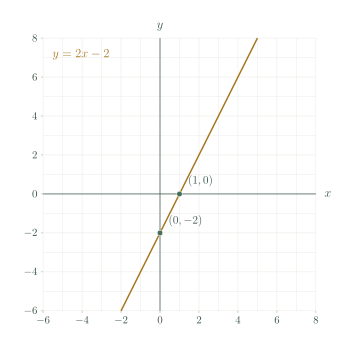
An intercept lies on an axis. On the horizontal axis, , so set to zero to find an -intercept. On the vertical axis, , so set to zero instead.
Write each intercept as an ordered pair to show which coordinate is zero. Horizontal lines have form and gradient zero. Vertical lines have form and require no numerical gradient or gradient-intercept form.
See the method in action.
Read a rule
For , state the gradient and both axis intercepts.
Worked solution
- 1
Match the gradient-intercept form.
The equation already has y isolated with coefficient 1.
- 2
Find the vertical-axis crossing.
Every point on the y-axis has x-coordinate zero.
- 3
Set the height to zero.
The x-axis consists of points whose y-coordinate is zero.
- 4
State the horizontal-axis crossing.
The solved x-value pairs with y equal to zero.
Gradient ; intercepts and .
Rearrange first
Find the gradient and -intercept of .
Worked solution
- 1
Move the x-term to the other side.
Subtracting 3x from both sides preserves equality.
- 2
Divide every term by two.
The coefficient of y must be 1 before reading the gradient.
- 3
Read the required features.
The coefficient of x is the gradient; the constant is the y-value at x equal to zero.
Gradient ; -intercept .
Try it yourself.
Check your understanding
What are the gradient and -intercept of ?
Show answer & reasoning
Gradient ; -intercept .
Comparing with gives and . The intercept is the point .
Keep practising
6 worksheet questions · 14 marks
Read the questions online
- State the gradient and -intercept of .2 marks
- Find both intercepts of .3 marks
- Write in gradient–intercept form.2 marks
- Give three points on using .3 marks
- Does the point lie on ? Explain.2 marks
- Describe and sketch the line .2 marks
Read the worked solutions
Equivalent correct methods earn the corresponding marks. Include units where asked.
- State the gradient and -intercept of .2 marks
Match and .
Gradient 4; . - Find both intercepts of .3 marks
Set to get .
Set : , so .
and . - Write in gradient–intercept form.2 marks
.
Divide by 2.
- Give three points on using .3 marks
Substitute each value into .
The resulting values are 1, 4 and 7.
, , . - Does the point lie on ? Explain.2 marks
Substitute : .
This matches the given -coordinate.
Yes. - Describe and sketch the line .2 marks
Two points are and .
Join them vertically; its gradient is undefined.
A vertical line through all points whose -coordinate is .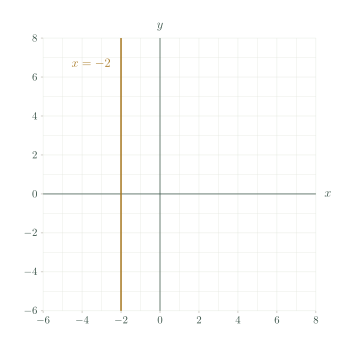
Curriculum reference & lesson scope
Australian Curriculum v9 and SA Curriculum Mathematics
Gradient, midpoint and distance; algebraic and graphical straight-line relationships; interpreting models and testing parameters. Parallel and perpendicular lines are included as a natural school-course extension. All explanations and questions are original.
Official curriculum source ↗