
Understand the idea.
Use a known point
A known gradient determines the steepness, but many parallel lines share it. Substitute that gradient into , then use the given point to determine which intercept places the line correctly.
Replace both coordinates together: a point means and . Solve the resulting equation for , then return to variables in the final rule so it describes every point on the line.
If two points are given
With two distinct points, first calculate the gradient using matching coordinate differences. Use either point to find the intercept, then substitute the other point as a separate check of the complete equation.
Check for special cases before dividing. Equal -coordinates give a vertical line with undefined gradient. Equal -coordinates give a horizontal line with gradient zero. Both still have valid equations.
See the method in action.
Given a gradient and point
Find the line of gradient 3 through .
Worked solution
- 1
Insert the known gradient.
Every non-vertical line of gradient 3 has this form.
- 2
Use the given point.
The coordinates of every point on the line satisfy its equation.
- 3
Solve for the intercept.
Subtract the contribution from the x-term.
- 4
Write and check the full rule.
The rule has gradient 3 and passes through the required point.
Given two points
Find the equation through and .
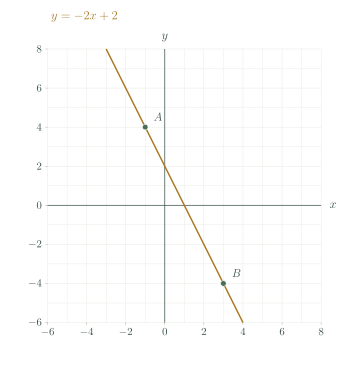
Worked solution
- 1
Calculate the gradient.
Use the same direction for both coordinate changes.
- 2
Substitute the first point.
The point (-1,4) lies on the required line.
- 3
Find the intercept and equation.
Subtracting 2 isolates the unknown intercept.
- 4
Check the second point.
The other endpoint independently confirms that the line passes through both points.
Try it yourself.
Check your understanding
Find the line of gradient through .
Show answer & reasoning
Begin with . Substituting gives , hence and . The point checks because .
Keep practising
6 worksheet questions · 14 marks
Read the questions online
- Find the line of gradient 2 through .2 marks
- Find the line of gradient through .2 marks
- Find the equation through and .3 marks
- Find the equation through and .3 marks
- Find the equation through and .2 marks
- A straight path passes through and . Write its equation and state its gradient.2 marks
Read the worked solutions
Equivalent correct methods earn the corresponding marks. Include units where asked.
- Find the line of gradient 2 through .2 marks
gives .
- Find the line of gradient through .2 marks
gives .
- Find the equation through and .3 marks
.
The first point gives .
- Find the equation through and .3 marks
.
gives .
- Find the equation through and .2 marks
The -coordinate is 5 at both points.
The line is vertical.
- A straight path passes through and . Write its equation and state its gradient.2 marks
Both points have the same -coordinate.
There is no vertical change, so .
; gradient 0.
Curriculum reference & lesson scope
Australian Curriculum v9 and SA Curriculum Mathematics
Gradient, midpoint and distance; algebraic and graphical straight-line relationships; interpreting models and testing parameters. Parallel and perpendicular lines are included as a natural school-course extension. All explanations and questions are original.
Official curriculum source ↗