
Understand the idea.
Change one thing at a time
The parameters and control different features of . Hold one fixed while changing the other, so a change in the graph can be traced to a single cause.
Predict first, then compare equations at matching inputs using a table or graphing tool. Record the axis scale and the parameter changed. Several examples help reveal a pattern; algebra is needed to justify a claim for every input.
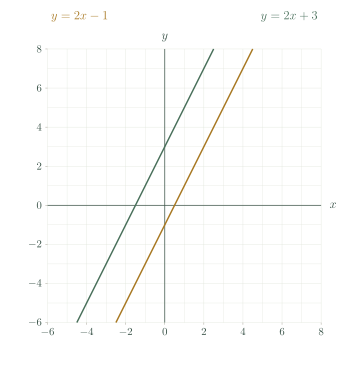
| x | y = 2x - 1 | y = 2x + 3 |
|---|---|---|
| -2 | -5 | -1 |
| -1 | -3 | 1 |
| 0 | -1 | 3 |
| 1 | 1 | 5 |
| 2 | 3 | 7 |
Explain the pattern algebraically
Changing only adds the same amount to every output, producing a vertical shift and equal gradients. Changing only leaves the point fixed, because the term vanishes there.
A larger gradient does not always give a higher graph. The sign of matters when comparing . Use an output difference to explain when one rule is higher, or one counterexample to refute an "always" claim.
See the method in action.
Predict an intercept change
Compare with . What changes?
Worked solution
- 1
Compare the gradients.
The coefficient of x is unchanged.
- 2
Subtract outputs at the same input.
The x-terms cancel for every real input, not just the values in a table.
- 3
Describe the resulting shift.
Every point moves up 4 units, so the two distinct lines remain parallel.
A vertical shift up 4 units; the gradient is unchanged.
Test a tempting claim
A student says is always above . Test the claim.
Worked solution
- 1
Try a positive input.
At x equal to 2, the first rule is higher, but one supporting case does not prove "always".
- 2
Test a negative input.
The negative input makes the larger x-coefficient produce a lower output.
- 3
Reject the universal claim.
One counterexample is sufficient to disprove a statement about every input.
- 4
Explain the full comparison.
The first line is lower for negative x, higher for positive x, and equal at (0,1).
The claim is false; gives a counterexample.
Try it yourself.
Check your understanding
If changes to , what happens to the graph?
Show answer & reasoning
It shifts down 3 units and remains parallel.
The output difference is for every . The line therefore moves down units and remains parallel because its gradient stays .
Keep practising
6 worksheet questions · 16 marks
Read the questions online
- Complete the outputs for and at .3 marks
- Predict the change from to without plotting.2 marks
- Where do , and all meet? Explain.2 marks
- For , which value or gives the larger output at ? Show both values.3 marks
- Design two distinct lines that meet at , then verify the common point.3 marks
- A graphing screen suggests and are the same line. Explain how to check.3 marks
Read the worked solutions
Equivalent correct methods earn the corresponding marks. Include units where asked.
- Complete the outputs for and at .3 marks
Substitute each input into both rules.
The first output is always 3 greater.
First rule: 1, 2, 3. Second rule: . - Predict the change from to without plotting.2 marks
The gradients are equal.
The intercept increases by .
A shift up 7 units; the lines are parallel. - Where do , and all meet? Explain.2 marks
For , the term is zero in each rule.
All three rules then give .
- For , which value or gives the larger output at ? Show both values.3 marks
For , .
For , .
gives 0, which is larger than for . - Design two distinct lines that meet at , then verify the common point.3 marks
Choose different gradients with the same intercept .
Substituting gives in both.
For example, and . - A graphing screen suggests and are the same line. Explain how to check.3 marks
The same gradient means they are parallel.
The different intercepts show they are not the same line.
A large viewing window can hide a small separation.
Compare exact equations or substitute : the outputs are 2 and 2.1, so the lines are distinct and parallel.
Curriculum reference & lesson scope
Australian Curriculum v9 and SA Curriculum Mathematics
Gradient, midpoint and distance; algebraic and graphical straight-line relationships; interpreting models and testing parameters. Parallel and perpendicular lines are included as a natural school-course extension. All explanations and questions are original.
Official curriculum source ↗