
Understand the method.
Apply the same operation to both sides. When dividing, the divisor must be nonzero.
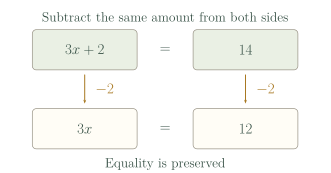
Do the same to both sides
An equation says that two expressions have the same value. Keep that equality true by adding, subtracting, multiplying or dividing both sides by the same amount.
Undo operations in reverse order to isolate the unknown. For , subtract from both sides, then divide both sides by .
Clear brackets and fractions carefully
Multiply every term inside a bracket by the outside number. A negative outside the bracket changes both signs: .
When a fraction has an expression above the line, multiply both sides by its denominator. Keep the whole numerator together before simplifying.
Collect terms, then check
With unknowns on both sides, collect the unknown terms on one side and the numbers on the other. Write the operation you use instead of guessing a new sign.
Check in the original equation: substitute your value into each side separately. Equal results confirm that the value works; unequal results mean you need to review the working.
See the method in action.
Undo a fraction and a bracket
Solve .
Worked solution
- 1
Multiply both sides by .
The denominator divides the whole numerator. Multiplying by undoes that division.
- 2
Divide both sides by , then add .
The factor multiplies the entire bracket, so division removes it without expansion.
- 3
Substitute into the original equation.
The left side equals the original right side, so the solution passes the check.
.
Handle a negative bracket and both sides
Solve .
Worked solution
- 1
Expand the bracket and collect the numbers on the left.
The product is . The negative factor applies to both terms.
- 2
Add to both sides.
This removes the unknown term on the left and leaves all the unknown terms on the right.
- 3
Subtract from both sides, then divide by .
The statement means the same as .
- 4
Check both original sides at .
Both sides give , including the original negative bracket.
.
Find when two costs match
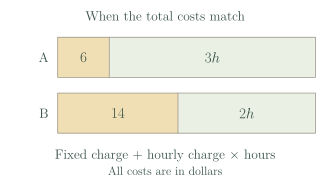
A bike hire plan costs dollars plus dollars per hour. A second plan costs dollars plus dollars per hour. For how many hours are the total costs equal?
Worked solution
- 1
Let be the number of hours and equate the costs.
Each cost is its fixed charge plus its hourly charge multiplied by the number of hours.
- 2
Subtract from both sides, then subtract .
The same operations on both sides preserve equality while isolating the number of hours.
- 3
Check the two costs at .
Each plan costs dollars, so the equal-cost condition holds.
The costs match after hours, when each plan costs dollars.
Try it yourself.
Calculate, explain, then apply.
Solve and check
Solve . Check your value in both original sides.
Show answer & reasoning
. Both original sides equal .
Subtract : . Subtract : . Divide by : . Check and . If you obtained , you added instead of undoing the addition.
Explain the error
A student rewrites as . Which term is wrong, and what is the correct solution?
Show answer & reasoning
The constant from the bracket should be . The correct solution is .
Multiply by both terms: . Then , so and . The error is the sign of the product , not a rule that every sign always changes.
Build an equation
One printing service charges dollars plus dollars per poster. Another charges dollars plus dollar per poster. How many posters make the total costs equal?
Show answer & reasoning
posters; each service costs dollars.
Let be the number of posters. Solve : subtract , then , giving . Check and . The fixed charge is added once; do not multiply it by the number of posters.
Keep practising
6 worksheet questions · 13 marks
Read the questions online
- Solve .2 marks
- Solve .2 marks
- Solve .2 marks
- Solve .2 marks
- Solve .2 marks
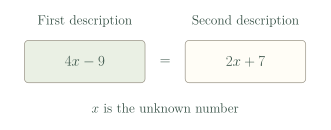
- A number is multiplied by 4 and then 9 is subtracted. The result equals twice the number plus 7. Find the number.3 marks
Read the worked solutions
Equivalent correct methods earn the corresponding marks. Include units where asked.
- Solve .2 marks
Subtract 5: .
Divide by 6: .
- Solve .2 marks
Subtract : .
Add 7 and divide by 5.
- Solve .2 marks
Divide by 3: .
Subtract 4.
- Solve .2 marks
Expand: .
Subtract 7: .
Divide by .
- Solve .2 marks
Multiply by 3: .
Subtract 5.
- A number is multiplied by 4 and then 9 is subtracted. The result equals twice the number plus 7. Find the number.3 marks
Let the number be . Then .
Subtract and add 9: .
Thus .
8
Curriculum reference & lesson scope
Australian Curriculum v9 and SA Curriculum Mathematics
Gradient, midpoint and distance; algebraic and graphical straight-line relationships; interpreting models and testing parameters. Parallel and perpendicular lines are included as a natural school-course extension. All explanations and questions are original.
Official curriculum source ↗