
Understand the idea.
Rise divided by run
Gradient measures the vertical change for each unit of horizontal change. Choose two distinct points, label them in an order, then subtract the coordinates in that same order in both parts of the fraction.
The ratio stays constant along a straight line. Reading from left to right, rising lines have positive gradient, falling lines have negative gradient, and horizontal lines have gradient zero. A vertical line has zero run, so its gradient is undefined.
Read the direction and units
A gradient of means a rise of for a run of , or a rise of for a run of . It describes a change, rather than the line's starting height.
Attach the graph's units to the ratio. If vertical coordinates are dollars and horizontal coordinates are hours, gradient is measured in dollars per hour. A negative gradient then describes a decrease in cost as time increases.
See the method in action.
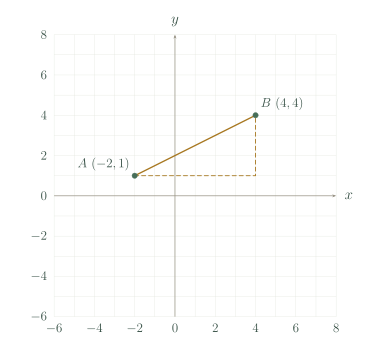
A positive gradient
Find the gradient through and .
Worked solution
- 1
Find the vertical change.
Read both coordinates from A to B.
- 2
Find the matching horizontal change.
Subtract the starting x-coordinate, including its negative sign.
- 3
Divide rise by run.
The line rises one unit for every two units to the right.
A falling line
Find the gradient through and .
Worked solution
- 1
Subtract in the same order.
Both changes run from the first point to the second.
- 2
Calculate the gradient.
Gradient is vertical change divided by horizontal change.
- 3
Interpret the sign and magnitude.
The line falls two units for each unit moved to the right.
Try it yourself.
Check your understanding
What is the gradient through and ?
Show answer & reasoning
0
The coordinates have the same height: . This is a horizontal line, with no vertical change.
Keep practising
6 worksheet questions · 14 marks
Read the questions online
- Find the gradient through and .2 marks
- Find the gradient through and .2 marks
- Find the gradient through and .2 marks
- Describe the gradient of the line .2 marks
- A tank contains 80 L at 2 minutes and 50 L at 8 minutes. Find the average gradient and explain it.3 marks
- Two points on a line are and . Its gradient is . Find .3 marks
Read the worked solutions
Equivalent correct methods earn the corresponding marks. Include units where asked.
- Find the gradient through and .2 marks
.
2 - Find the gradient through and .2 marks
.
- Find the gradient through and .2 marks
.
- Describe the gradient of the line .2 marks
Every point has the same -coordinate.
The run is zero, so division by the run is not defined.
Undefined - A tank contains 80 L at 2 minutes and 50 L at 8 minutes. Find the average gradient and explain it.3 marks
.
The negative sign represents a decrease.
L/min; the tank loses an average of 5 L per minute over this interval. - Two points on a line are and . Its gradient is . Find .3 marks
.
Thus , giving .
Curriculum reference & lesson scope
Australian Curriculum v9 and SA Curriculum Mathematics
Gradient, midpoint and distance; algebraic and graphical straight-line relationships; interpreting models and testing parameters. Parallel and perpendicular lines are included as a natural school-course extension. All explanations and questions are original.
Official curriculum source ↗