
Understand the idea.
Same steepness, different line
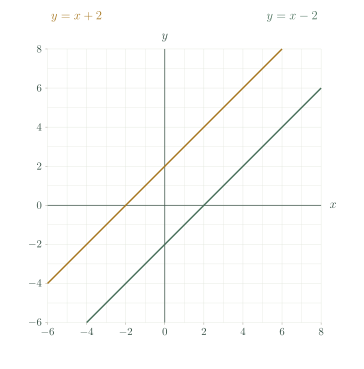
Distinct non-vertical parallel lines have equal gradients. At matching horizontal positions, their outputs differ by a constant amount. Different intercepts distinguish two parallel lines from two equations describing the same line.
Isolate before comparing gradients. For example, becomes , so it is parallel to . Distinct vertical lines are parallel too, although their gradients are undefined.
A right-angle relationship
For perpendicular lines with finite non-zero gradients, . Taking the reciprocal and changing the sign produces the required partner. Thus pairs with , since their product is .
Horizontal and vertical lines also meet at right angles, but the gradient product cannot describe that case. When a required line passes through a specified point, determine its intercept as well as its gradient.
See the method in action.
A parallel line through a point
Find the line parallel to through .
Worked solution
- 1
Use the same gradient.
A parallel non-vertical line has the original line's gradient.
- 2
Substitute the required point.
The line must pass through (1,-1).
- 3
Solve for its intercept.
Subtract the x-term from the point's y-coordinate.
- 4
Write and verify the line.
Its gradient is 3 and its different intercept makes it a distinct parallel line.
A perpendicular line
Find the line perpendicular to through .
Worked solution
- 1
Find the perpendicular gradient.
Finite non-zero perpendicular gradients multiply to -1.
- 2
Use the specified point.
Substitution places the new line through (2,1).
- 3
Find the intercept and rule.
Adding 4 to both sides isolates the intercept.
- 4
Check the point.
The equation satisfies both the required gradient and location.
Try it yourself.
Check your understanding
What gradient is perpendicular to ?
Show answer & reasoning
The negative reciprocal of is . Check the defining relationship: .
Keep practising
6 worksheet questions · 15 marks
Read the questions online
- Are and parallel? Explain.2 marks
- Find the gradient of a line perpendicular to .2 marks
- Find the line parallel to through .3 marks
- Find the line perpendicular to through .3 marks
- Find a line through perpendicular to .2 marks
- Show that and meet at right angles.3 marks
Read the worked solutions
Equivalent correct methods earn the corresponding marks. Include units where asked.
- Are and parallel? Explain.2 marks
Both are in form.
Their gradients are equal and their intercepts differ.
Yes; they are distinct lines with equal gradient 2. - Find the gradient of a line perpendicular to .2 marks
Take the negative reciprocal of .
.
- Find the line parallel to through .3 marks
Use gradient : .
Thus .
- Find the line perpendicular to through .3 marks
The perpendicular gradient is .
gives .
- Find a line through perpendicular to .2 marks
is horizontal.
A perpendicular line is vertical and must pass through .
- Show that and meet at right angles.3 marks
Rearrange: and .
Multiply the gradients: .
Their gradients are and , whose product is .
Curriculum reference & lesson scope
Australian Curriculum v9 and SA Curriculum Mathematics
Gradient, midpoint and distance; algebraic and graphical straight-line relationships; interpreting models and testing parameters. Parallel and perpendicular lines are included as a natural school-course extension. All explanations and questions are original.
Official curriculum source ↗