
Understand the idea.
Shift the basic curve
In turning-point form, , the square reaches its smallest value at . The turn is therefore , and the symmetry axis is . This gives a reliable way to read horizontal shifts.
A positive shifts the basic parabola right; a negative shifts it left. The outside constant shifts every output vertically. For , the square vanishes at , giving minimum .
Change the coefficient
In , require for a parabola. The sign of sets the opening. Its magnitude scales vertical distances from the turn: gives a narrower appearance on unchanged axes.
When graphing, keep the window and axis scales fixed and vary one parameter at a time. Use the rule to predict the turn and a few matching outputs; this distinguishes a genuine transformation from a changed display scale.
See the method in action.
Worked example
Describe compared with .
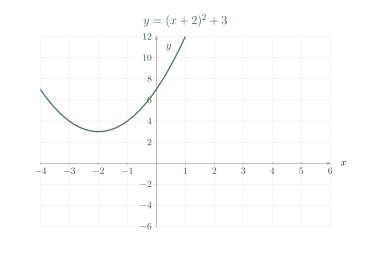
Worked solution
- 1
Find where the bracket vanishes.
The squared term has its minimum when the bracket is zero.
- 2
Calculate the minimum output.
At that input, only the outside constant remains.
- 3
Identify the translation.
The basic turn moves two units left and three units up.
- 4
Check the scale and opening.
The squared-term coefficient stays 1, so the translated curve retains its width and upward opening.
Two units left and three up; turning point .
Worked example
Compare with .
Worked solution
- 1
Relate the outputs algebraically.
Every original output is multiplied by -2 for the same input.
- 2
Compare representative values.
The sign reverses and each vertical magnitude doubles.
- 3
Check the turning point.
The turn stays at (0,0) and becomes a maximum.
- 4
Describe the transformation.
The graph reflects across the x-axis and stretches vertically by factor 2, so it opens downwards.
It opens downwards and has double the vertical magnitude at each input.
Try it yourself.
Check your understanding
Give the turning point of .
Show answer & reasoning
The square in is zero at , giving . Since the square cannot be negative, this is the minimum turning point .
Keep practising
6 worksheet questions · 14 marks
Read the questions online
- State the turning point and axis of .2 marks
- State the turning point of .2 marks
- Which opens downwards: or ?2 marks
- At , compare the outputs of and .2 marks
- Write a quadratic rule with the same shape as and turning point .3 marks
- A graphing experiment changes from to . Describe what changes and what stays the same.3 marks
Read the worked solutions
Equivalent correct methods earn the corresponding marks. Include units where asked.
- State the turning point and axis of .2 marks
The bracket is zero at and the output there is .
; . - State the turning point of .2 marks
when .
- Which opens downwards: or ?2 marks
The coefficient of the squared term is negative.
- At , compare the outputs of and .2 marks
and .
and ; the second is triple. - Write a quadratic rule with the same shape as and turning point .3 marks
Use a bracket zero at , then shift down .
- A graphing experiment changes from to . Describe what changes and what stays the same.3 marks
The output increases by for every input.
Only the constant outside the square changes.
Every point moves up units; shape, axis and upward opening stay the same.
Curriculum reference & lesson scope
Australian Curriculum v9 / SA Curriculum Mathematics
AC9M9A02, AC9M9A04–A06: monic quadratic expressions, integer-root equations, graphs and models.
Official curriculum source ↗