
Understand the idea.
Make a right triangle
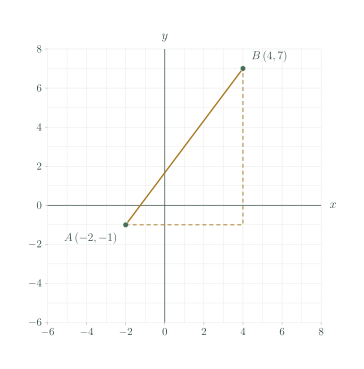
Draw a horizontal step and a vertical step between the two points. These form perpendicular legs of a right triangle; the direct segment is its hypotenuse. Their lengths come from the coordinate differences.
Pythagoras' theorem adds the squares of the legs. Signed differences may be negative, but squaring removes the sign. Take the non-negative square root at the end because a distance cannot be negative.
Exact or approximate?
Keep a square-root answer exact unless a decimal approximation is requested. A perfect-square total gives an integer distance; otherwise retain the radical while working and round the final decimal only once.
On horizontal or vertical segments, one coordinate difference is zero, so the formula reduces to the size of the other difference. Include units: the result measures direct separation, rather than a route along grid lines.
See the method in action.
A coordinate triangle
Find the distance from to .
Worked solution
- 1
Find the two perpendicular changes.
The coordinate differences give the horizontal and vertical legs.
- 2
Apply Pythagoras.
The direct segment is the hypotenuse of this right triangle.
- 3
Take the non-negative square root.
Distance is a non-negative length.
10 units
A non-integer distance
Find the distance between and , first exactly and then to 2 decimal places.
Worked solution
- 1
Calculate the coordinate changes.
The two perpendicular legs have lengths 4 and 5.
- 2
Find the exact distance.
Pythagoras gives an exact radical because 41 is not a perfect square.
- 3
Round the decimal at the end.
The third decimal digit is 3, so the hundredths digit stays unchanged.
units; approximately 6.40 units
Try it yourself.
Check your understanding
Find the distance between and .
Show answer & reasoning
10 units
The legs are and , so .
Keep practising
6 worksheet questions · 16 marks
Read the questions online
- Find the distance between and .2 marks
- Find the distance between and .2 marks
- Find the exact distance between and .2 marks
- Find the exact distance between and , then round it to 1 decimal place.3 marks
- A map grid uses 100 m per coordinate unit. A gate is at and a shelter at . Find their straight-line separation.3 marks
- Points , and form a triangle. Find its perimeter.4 marks
Read the worked solutions
Equivalent correct methods earn the corresponding marks. Include units where asked.
- Find the distance between and .2 marks
The changes are 3 and 4.
.
5 units - Find the distance between and .2 marks
The changes are 8 and 6.
.
10 units - Find the exact distance between and .2 marks
The changes are 3 and 4.
.
5 units - Find the exact distance between and , then round it to 1 decimal place.3 marks
The changes are 5 and 2.
.
To 1 decimal place this is 5.4.
units; 5.4 units - A map grid uses 100 m per coordinate unit. A gate is at and a shelter at . Find their straight-line separation.3 marks
The grid distance is units.
Multiply by 100 m per unit.
500 m - Points , and form a triangle. Find its perimeter.4 marks
and .
.
The perimeter is .
24 units
Curriculum reference & lesson scope
Australian Curriculum v9 and SA Curriculum Mathematics
Gradient, midpoint and distance; algebraic and graphical straight-line relationships; interpreting models and testing parameters. Parallel and perpendicular lines are included as a natural school-course extension. All explanations and questions are original.
Official curriculum source ↗