
Understand the idea.
Solve by looking for the same height
A graphical solution is an input where a target relationship holds. For , read horizontal intercepts; for , read intersections, where the two rules give equal outputs.
Subtracting the rules produces the equivalent equation . Its roots have the same input coordinates as the intersections, although its graph does not share their original heights.
Narrow an interval rather than guess
Polynomials are continuous, so opposite signs at interval endpoints guarantee at least one root between them. Evaluate closer inputs to narrow that interval until every possible value rounds to the same requested result.
A sign change does not show every root: a repeated root can touch zero and turn back without changing sign. Graphical estimates and numerical brackets are approximations; keep an exact algebraic expression when an exact answer is required.
See the method in action.
A positive root to two decimals
Estimate the positive solution of to two decimal places.
| x | 1.40 | 1.41 | 1.42 |
|---|---|---|---|
| x²−2 | −0.0400 | −0.0119 | 0.0164 |
Worked solution
- 1
Create a zero-finding function.
The required positive solution is the positive root of this continuous polynomial.
- 2
Bracket the positive root.
The sign change places a root between and ; squaring increases for positive inputs.
- 3
Refine around the rounding boundary.
The root lies above and strictly below , the boundary for rounding up to .
- 4
Round only after securing the interval.
Every value in this interval rounds to the same hundredth, so the two-decimal estimate is justified.
Intersect a line and a parabola
Find the intersections of and .
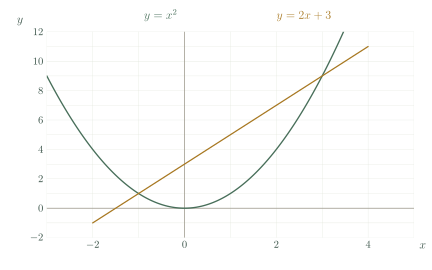
Worked solution
- 1
Set the heights equal.
An intersection point satisfies both rules with the same input and output.
- 2
Rearrange and factor.
The constants and multiply to and add to .
- 3
Solve for both horizontal coordinates.
Each zero factor gives one intersection input.
- 4
Calculate and check the common heights.
Both rules agree, so the intersections are and .
and
Try it yourself.
Check your understanding
What equation locates intersections of and ?
Show answer & reasoning
, or .
Equal heights require . Subtracting from both sides gives the equivalent equation , whose roots locate the intersection inputs.
Keep practising
6 worksheet questions · 16 marks
Read the questions online
- Use the table to locate the positive root of between two listed values.2 marks
1.6 1.7 1.8 −0.44 −0.11 0.24 - Estimate both roots of to two decimal places.2 marks
- Find the intersections of and .3 marks
- Use the supplied values to round the positive root of to two decimal places.3 marks
0.618 0.619 −0.000076 0.002161 - Solve exactly, then give decimal answers to two places.3 marks
- Why does a sign-change search miss the root of if it checks only and ?3 marks
Read the worked solutions
Equivalent correct methods earn the corresponding marks. Include units where asked.
- Use the table to locate the positive root of between two listed values.2 marks
1.6 1.7 1.8 −0.44 −0.11 0.24 and have opposite signs.
- Estimate both roots of to two decimal places.2 marks
The exact roots are .
- Find the intersections of and .3 marks
; then .
and - Use the supplied values to round the positive root of to two decimal places.3 marks
0.618 0.619 −0.000076 0.002161 The root is between and , so it rounds to .
- Solve exactly, then give decimal answers to two places.3 marks
Complete the square: .
- Why does a sign-change search miss the root of if it checks only and ?3 marks
, but the curve touches the axis at its repeated root .
Both endpoint values are positive even though .
Curriculum reference & lesson scope
Australian Curriculum v9.0 and South Australian Curriculum
Year 10 quadratics, including the fuller school-course algebra requested for Ascent: non-monic factorisation, completing the square and the quadratic formula. These lessons consolidate Year 9 monic quadratics and extend the available solving methods.
Official curriculum source ↗