
Understand the idea.
Centre and chord
Drawing a perpendicular from a circle’s centre to a chord divides the chord into equal halves. Either half, the perpendicular distance and a radius form a right triangle, with the radius as hypotenuse.
The converse also holds for a non-diameter chord: joining its midpoint to the centre produces a perpendicular. An arbitrary interior point cannot replace the centre because its distances to the chord endpoints need not be equal.
Tangents meet radii at right angles
At the contact point, a tangent is perpendicular to the radius. Join the centre to an exterior point to form a right triangle, then identify its hypotenuse before applying Pythagoras.
Two tangent segments from the same exterior point to the same circle have equal lengths. The shared exterior point matters; tangents drawn from unrelated points need not have matching lengths.
See the method in action.
Distance to a chord
A circle has centre O, radius 5 cm and chord AB of length 8 cm. M is the foot of the perpendicular from O to AB. Find OM.
Worked solution
- 1
Halve the chord.
The perpendicular from the centre bisects the chord.
- 2
Use the radius as hypotenuse.
Triangle OMA is right-angled at M and OA is a radius.
- 3
Take the positive square root.
OM represents a distance, so it cannot be negative.
3 cm
Tangent length
PA is tangent at A. The circle centre is O, OA=5 cm and OP=13 cm. Find PA.
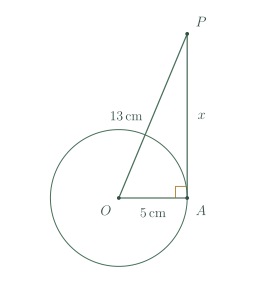
Worked solution
- 1
Identify the right angle.
A radius is perpendicular to the tangent at the point of contact.
- 2
Subtract the squared radius.
OP lies opposite the right angle, so OP is the hypotenuse.
- 3
Find the tangent length.
The positive root gives the length of segment PA.
12 cm
Try it yourself.
Check your understanding
Two tangent segments PA and PB from the same external point touch one circle. PA=7 cm. Find PB.
Show answer & reasoning
7 cm
The segments PA and PB are tangents from the same exterior point P to one circle, so .
Keep practising
6 worksheet questions · 13 marks
Read the questions online
- A radius 13 cm circle has chord length 10 cm. Find the perpendicular distance from centre to chord.2 marks
- A chord is 12 cm long and 3 cm from the centre. Find the radius.2 marks
- A tangent from P has length 15 cm and the radius to its contact point is 8 cm. Find the centre-to-P distance.2 marks
- Tangents PA and PB from P have lengths and . Find and the common tangent length.2 marks
- A radius 10 cm circle has a chord 16 cm long. A student uses . Explain the error and give the correct distance.3 marks
- A line joins the circle centre to the midpoint of a non-diameter chord. What angle does it make with the chord?2 marks
Read the worked solutions
Equivalent correct methods earn the corresponding marks. Include units where asked.
- A radius 13 cm circle has chord length 10 cm. Find the perpendicular distance from centre to chord.2 marks
Half-chord 5 cm.
.
12 cm - A chord is 12 cm long and 3 cm from the centre. Find the radius.2 marks
.
cm - A tangent from P has length 15 cm and the radius to its contact point is 8 cm. Find the centre-to-P distance.2 marks
.
17 cm - Tangents PA and PB from P have lengths and . Find and the common tangent length.2 marks
gives .
.
; length 11 - A radius 10 cm circle has a chord 16 cm long. A student uses . Explain the error and give the correct distance.3 marks
The right-triangle leg is 8, not 16.
.
Use half the chord; distance 6 cm. - A line joins the circle centre to the midpoint of a non-diameter chord. What angle does it make with the chord?2 marks
The point must be the circle’s centre and the other point the chord midpoint.
.
Curriculum reference & lesson scope
Australian Curriculum v9 and SA Curriculum
Angle and similarity reasoning; congruent/similar triangles in proofs; chords, radii and tangents; angles at the centre and circumference; circle theorems and their applications; connected deductive arguments; construction/spatial algorithms; testing and justifying solutions.
Official curriculum source ↗