
Understand the idea.
Start with one complete cycle
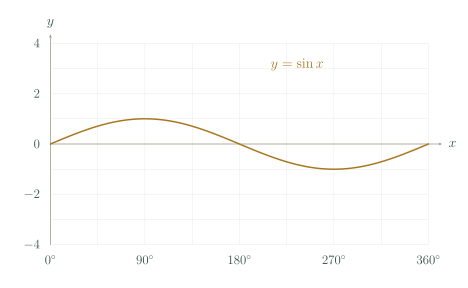
A basic sine cycle begins at zero, rises to after a quarter-turn, crosses zero after a half-turn, reaches after three quarters and returns to zero after a full turn. Cosine begins at its maximum.
Both curves repeat every . Plot key points on labelled axes and join them smoothly; sharp line segments do not represent the continuously changing coordinates of a rotating point on the unit circle.
Read the parameters
For or in degrees, with , the amplitude is , period is and midline is . The range is .
A negative reflects the curve in its midline. Unit-circle reflection also explains and . If or is zero, the function is constant and has no fundamental period.
See the method in action.
Read a transformed rule
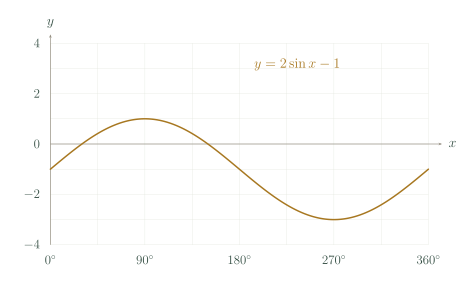
State amplitude, period, midline and range for y = 2 sin x − 1.
Worked solution
- 1
Identify the coefficients.
Compare the rule with .
- 2
Find amplitude and period.
Vertical scaling controls amplitude; the inside multiplier controls cycle length.
- 3
Find the midline and range.
The graph extends two units above and below its midline.
Amplitude 2; period 360°; midline y = −1; −3 ≤ y ≤ 1.
A compressed cosine graph
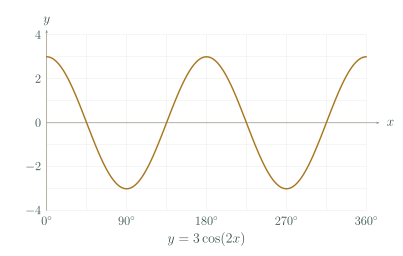
For y = 3 cos(2x), state the period and the first maximum and minimum at or after x = 0°.
Worked solution
- 1
Calculate the compressed period.
The inside angle completes one turn while advances by .
- 2
Locate the first maximum.
Cosine starts at its maximum, giving .
- 3
Locate the first minimum.
Cosine first reaches after half an inside-angle cycle, giving .
Period 180°; maximum (0°,3); minimum (90°,−3).
Try it yourself.
Check your understanding
Find the amplitude and period of y = 4 sin(2x) + 1.
Show answer & reasoning
Amplitude 4; period 180°.
For , amplitude is and period is . The upward shift changes neither quantity.
Keep practising
6 worksheet questions · 17 marks
Read the questions online
- State the amplitude, period and range of .3 marks
- Give at , , , and .2 marks
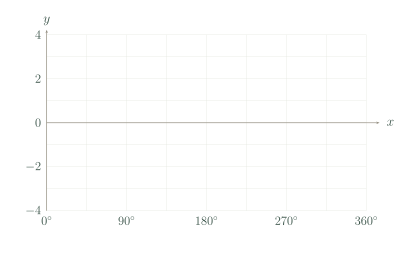
- Sketch for on the supplied grid. Label the intercepts and turning points.4 marks
- Describe how differs from .2 marks
- Explain why using the unit circle.3 marks
- A sine graph has maximum 3, minimum and period . It crosses its midline upwards at . Give a rule.3 marks
Read the worked solutions
Equivalent correct methods earn the corresponding marks. Include units where asked.
- State the amplitude, period and range of .3 marks
Use and .
Add and subtract 4 from the midline 1.
Amplitude 4; period ; . - Give at , , , and .2 marks
Use the -coordinates of the unit-circle points.
1, 0, , 0, 1. - Sketch for on the supplied grid. Label the intercepts and turning points.4 marks
Evaluate sine at .
Plot the five key points and join with a smooth periodic curve.
Intercepts , , ; maximum ; minimum .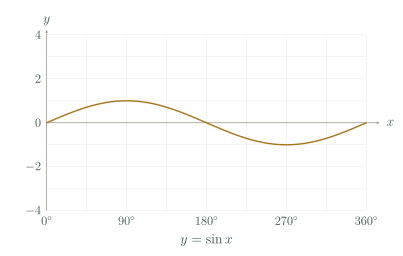
- Describe how differs from .2 marks
Every -value changes sign.
Both amplitudes are 2 and periods .
It is reflected in the -axis; amplitude and period stay the same. - Explain why using the unit circle.3 marks
The two points have opposite vertical coordinates.
Sine is the vertical coordinate.
Reflection across the -axis keeps -coordinate but reverses -coordinate. - A sine graph has maximum 3, minimum and period . It crosses its midline upwards at . Give a rule.3 marks
Midline .
Amplitude .
An upward midline crossing at matches sine.
.
Curriculum reference & lesson scope
Australian Curriculum v9 and South Australian school course scope
Right-triangle applications include AC9M10M03. The approved chapter also develops non-right-triangle methods, exact values and trigonometric functions within one normal Year 10 course.
Official curriculum source ↗