
Understand the idea.
Draw the boundary before shading
A linear inequality in two variables selects a half-plane. Replace the inequality by equality to draw its boundary. Use a solid boundary when equality is permitted and a dashed boundary for a strict inequality; boundary points are then excluded.
Choose a point away from the boundary and substitute it into the original inequality. A true result selects the side containing that point; a false result selects the other side. A point on the boundary cannot distinguish the sides.
More than one condition
A feasible region contains points satisfying every condition together. Shade the overlap, including or excluding each boundary as required. Axis restrictions such as and include the axes. For object counts, only nonnegative whole-number points in the overlap are meaningful.
See the method in action.
A triangular feasible region
Describe the region , , .
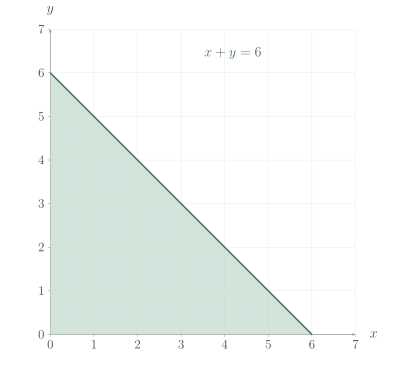
Worked solution
- 1
Apply the nonnegative coordinate conditions.
These select the first quadrant together with its axes.
- 2
Find the intercepts of the remaining boundary.
The line passes through and ; equality means it is solid.
- 3
Test the origin to choose the allowed side.
The true statement selects the half-plane containing the origin.
- 4
Describe the intersection.
The three included boundaries enclose the closed triangle with these vertices, including its interior.
The closed triangle with vertices .
A strict boundary
Which side of satisfies ?
Worked solution
- 1
Draw the boundary with the correct style.
The original inequality is strict, so the line is dashed and its points are excluded.
- 2
Test a point away from the line.
The origin is not on the boundary and makes the original inequality true.
- 3
Identify the selected half-plane.
For each fixed , allowed values are less than the line height, so shade below the dashed line.
Below the dashed line, excluding the boundary.
Try it yourself.
Check your understanding
Does satisfy and ?
Show answer & reasoning
Yes.
At , the first condition gives and the second gives . Both are true, so the point belongs to their overlap.
Keep practising
6 worksheet questions · 15 marks
Read the questions online
- Decide whether satisfies .2 marks
- Is the boundary of solid or dashed? Which side is allowed?2 marks
- Find the intercepts of the boundary .2 marks
- Give the vertices of the feasible region , , .3 marks
- On the supplied grid, shade the region , , .3 marks
- A stall sells necklaces for 5 dollars and bracelets for 3 dollars. Write inequalities for buying at least 4 items using no more than 24 dollars. Define the variables.3 marks
Read the worked solutions
Equivalent correct methods earn the corresponding marks. Include units where asked.
- Decide whether satisfies .2 marks
.
Yes. - Is the boundary of solid or dashed? Which side is allowed?2 marks
Equality is excluded and larger values are required.
Dashed; above the line. - Find the intercepts of the boundary .2 marks
Set each variable to zero in turn.
and - Give the vertices of the feasible region , , .3 marks
The boundary intercepts and origin form the triangle.
- On the supplied grid, shade the region , , .3 marks
The origin passes the inequality test.
The first-quadrant triangle below the dashed line from to ; the sloping boundary is excluded.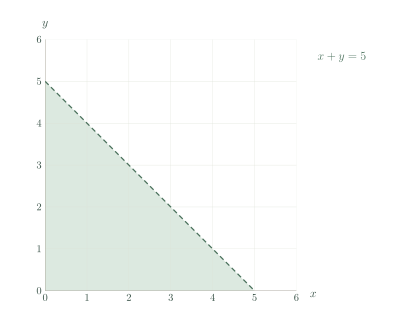
- A stall sells necklaces for 5 dollars and bracelets for 3 dollars. Write inequalities for buying at least 4 items using no more than 24 dollars. Define the variables.3 marks
Let count necklaces and count bracelets; total items and total cost give the two conditions.
, , with nonnegative integers.
Curriculum reference & lesson scope
Australian Curriculum v9 and South Australian Mathematics Curriculum
Year 10 simultaneous equations and inequalities with graphical, algebraic and practical interpretations.
Official curriculum source ↗