
Understand the idea.
A pair must satisfy both equations
A simultaneous solution is an ordered pair that makes both equations true at once. Graphically it lies on both lines, at their intersection. A plotted intersection suggests the coordinates; substitution checks whether the values are exact rather than a reading estimate.
Choose a method that fits
Use substitution when one variable is already isolated: replace that variable in the other equation with its equal expression. This leaves one equation in one variable. After solving it, substitute back to find the second coordinate.
Use elimination when matching coefficients are easy to create. Multiply a whole equation by a nonzero number, then add or subtract the equations so one variable cancels. Find both variables and check the ordered pair in both original equations.
See the method in action.
Read and check an intersection
Solve and .
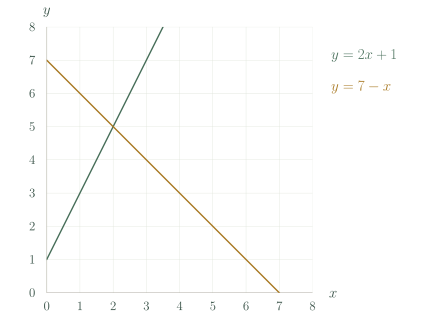
Worked solution
- 1
Equate the two expressions for .
At an intersection, both lines have the same coordinate and the same value.
- 2
Solve for the common coordinate.
Add to both sides, subtract , then divide by .
- 3
Find the corresponding coordinate.
The first line supplies once is known.
- 4
Check the pair in the second equation.
The pair satisfies both equations, so it is their intersection.
Eliminate a variable
Solve and .
Worked solution
- 1
Create opposite coefficients for .
Multiply the first original equation by and the second by .
- 2
Add the equations and solve for .
The and cancel when the equations are added.
- 3
Substitute into the second original equation.
Using leaves a linear equation for .
- 4
Verify both original equations.
Both equalities hold, establishing as the solution.
Try it yourself.
Check your understanding
Solve and .
Show answer & reasoning
Substitute into : , so and . The pair gives and .
Keep practising
6 worksheet questions · 14 marks
Read the questions online
- Solve and .2 marks
- Solve and .2 marks
- Solve and .2 marks
- Solve and .2 marks
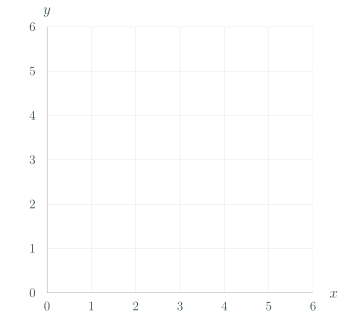
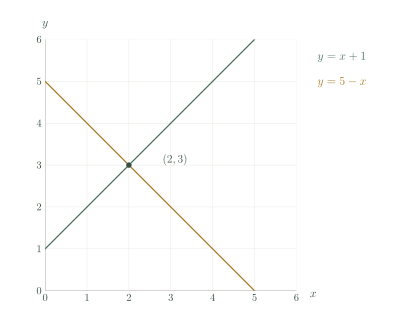
- On the supplied grid, draw and , then state their intersection.3 marks
- Three adult tickets and two child tickets cost 46 dollars. One adult ticket and two child tickets cost 26 dollars. Find both prices.3 marks
Read the worked solutions
Equivalent correct methods earn the corresponding marks. Include units where asked.
- Solve and .2 marks
Add the equations to get ; then .
- Solve and .2 marks
gives , then .
- Solve and .2 marks
Eliminate : minus gives .
- Solve and .2 marks
Use : , so .
- On the supplied grid, draw and , then state their intersection.3 marks
Both lines give at .
- Three adult tickets and two child tickets cost 46 dollars. One adult ticket and two child tickets cost 26 dollars. Find both prices.3 marks
Subtract the equations to obtain two adult tickets costing 20 dollars.
Substitute the adult price into the second total.
Adult: 10 dollars; child: 8 dollars.
Curriculum reference & lesson scope
Australian Curriculum v9 and South Australian Mathematics Curriculum
Year 10 simultaneous equations and inequalities with graphical, algebraic and practical interpretations.
Official curriculum source ↗