
Understand the idea.
Multiply for each equal step
For with and , increasing by multiplies the output by . This produces growth when and decay when .
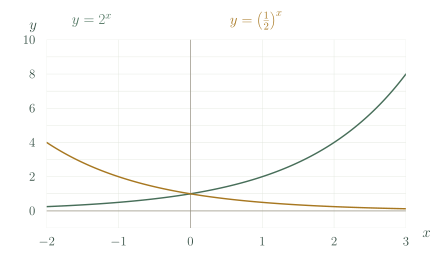
Build a table around : the zero power gives , and negative powers give reciprocals. Moving backwards one input step divides by . The basic exponential therefore passes through and always has positive outputs.
Read the whole shape
The basic real exponential has domain all real and range . Its horizontal asymptote is : the curve can approach that line arbitrarily closely but never meets it.
Plot table points and join them with a smooth curve when modelling real inputs. Include points on both sides of zero to reveal the shape. A table at integer inputs samples the curve; it does not make the function a staircase.
See the method in action.
A growth table
For , find the values at .
| x | −2 | −1 | 0 | 1 | 2 | 3 |
|---|---|---|---|---|---|---|
| y | 1/4 | 1/2 | 1 | 2 | 4 | 8 |
Worked solution
- 1
Evaluate the negative powers.
Negative indices give reciprocal powers.
- 2
Evaluate zero and positive powers.
Each unit input step doubles the previous output.
- 3
List outputs in the requested input order.
These correspond respectively to .
A decay intercept
Find the -intercept of .
Worked solution
- 1
Locate the vertical axis.
Every point on the -axis has horizontal coordinate zero.
- 2
Evaluate the function there.
A nonzero base raised to zero is .
- 3
State the intercept as a point.
An intercept includes both the input coordinate and output coordinate.
Try it yourself.
Check your understanding
What multiplier connects consecutive outputs of ?
Show answer & reasoning
3
The factor is , since . This compares outputs for an input increase of exactly .
Keep practising
6 worksheet questions · 14 marks
Read the questions online
- Find when in .2 marks
- Find the -intercept of .2 marks
- State whether increases or decreases as increases.2 marks
- For , calculate the outputs at and exactly.3 marks
- State the domain and range of .2 marks
- A culture starts with units and doubles each hour. Write its model and find its size after 3 hours.3 marks
Read the worked solutions
Equivalent correct methods earn the corresponding marks. Include units where asked.
- Find when in .2 marks
.
- Find the -intercept of .2 marks
Set : .
- State whether increases or decreases as increases.2 marks
Each step multiplies by , a factor below .
Decreases - For , calculate the outputs at and exactly.3 marks
and .
and - State the domain and range of .2 marks
A positive-base exponential is defined for all real inputs and always positive.
Domain: all real ; range: . - A culture starts with units and doubles each hour. Write its model and find its size after 3 hours.3 marks
The initial multiplier is and the hourly factor is . At , .
; 32 units.
Curriculum reference & lesson scope
Australian Curriculum v9 and SA Curriculum Mathematics
Integer and fractional index laws; connecting fractional powers with roots; simplifying surds; operations with surds; rationalising denominators; exact and approximate values; exponential tables and graphs; growth/decay factors; comparing linear/quadratic/exponential patterns; exponential equations; logarithms as inverses; logarithm laws; interpreting logarithmic scales; graph transformations and parameter experiments; choosing and evaluating models.
Official curriculum source ↗