
Understand the idea.
Three possible relationships
Two nonparallel straight lines intersect once, giving one solution. Distinct parallel lines have no common point, while coincident lines share every point on the line. Rewriting equations in gradient-intercept form can help identify which relationship occurs.
Read the algebraic conclusion
Elimination can identify these cases without drawing. If the variable terms cancel and leave a false statement such as , no pair can satisfy both equations. A contradiction is a conclusion, not an instruction to continue isolating a variable.
If elimination leaves , one equation repeats the other and supplies no extra restriction. Keep the remaining equation: infinitely many pairs lie on that line, but points elsewhere in the plane still fail the system.
See the method in action.
No common point
Solve and .
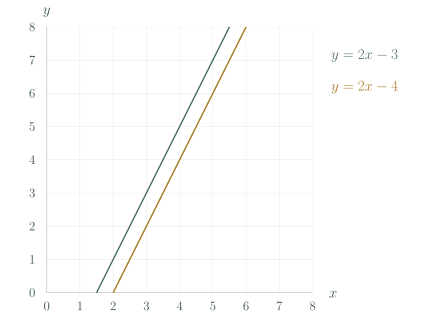
Worked solution
- 1
Match the left sides.
Doubling the entire first equation preserves its solution line.
- 2
Compare it with the second equation.
The same expression would have to equal two different constants.
- 3
Subtract to expose the contradiction.
No ordered pair can make this false equality true, so the system has no solution.
No solution
The same line twice
Solve and .
Worked solution
- 1
Double the first equation.
This is exactly the second equation, so both describe the same line.
- 2
Eliminate to identify the repeated condition.
The identity adds no restriction beyond .
- 3
Describe all pairs on the common line.
Any real choice of gives , and doubling this equality satisfies the second equation.
Infinitely many: all points on .
Try it yourself.
Check your understanding
How many solutions do and have?
Show answer & reasoning
None.
The two lines both have gradient but different intercepts. Equating their values gives , hence , so they have no intersection and no solution.
Keep practising
6 worksheet questions · 14 marks
Read the questions online
- Classify the solution set of and .2 marks
- Classify and .2 marks
- Classify and .2 marks
- Explain why does not mean that every pair of real numbers solves and .3 marks
- Find the value of for which and have infinitely many solutions.2 marks
- Two taxi companies charge the same 2 dollars per kilometre. Their starting fees are 4 and 7 dollars. Can the trip prices ever be equal for the same distance?3 marks
Read the worked solutions
Equivalent correct methods earn the corresponding marks. Include units where asked.
- Classify the solution set of and .2 marks
The gradients differ.
One solution. - Classify and .2 marks
The second equation is twice the first.
Infinitely many points on . - Classify and .2 marks
Doubling the first would give right side , not .
No solution. - Explain why does not mean that every pair of real numbers solves and .3 marks
For example, fails the original equation although the equations are dependent.
The original condition still applies. - Find the value of for which and have infinitely many solutions.2 marks
Their intercepts must match.
- Two taxi companies charge the same 2 dollars per kilometre. Their starting fees are 4 and 7 dollars. Can the trip prices ever be equal for the same distance?3 marks
The models are parallel lines separated by 3 dollars for every distance.
No.
Curriculum reference & lesson scope
Australian Curriculum v9 and South Australian Mathematics Curriculum
Year 10 simultaneous equations and inequalities with graphical, algebraic and practical interpretations.
Official curriculum source ↗