
Understand the idea.
Coordinates extend the triangle ratios
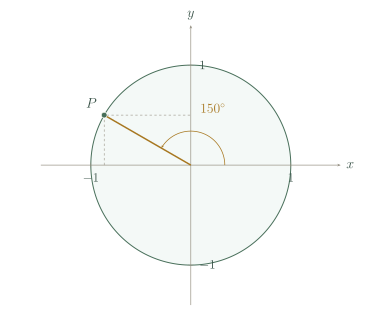
On the unit circle, turn anticlockwise from through angle . The resulting point is . This extends the right-triangle definitions to angles beyond the first quadrant.
Cosine is the horizontal coordinate and sine is the vertical coordinate. Determine their signs from the point's quadrant: left means negative cosine, while below the horizontal axis means negative sine.
Use a reference angle and a quadrant
A reference angle is the acute angle between the radius and the horizontal axis. Use a special triangle or inverse ratio to find coordinate magnitudes, then apply the signs determined by the quadrant.
A full turn of returns to the same point. Also, is undefined when the horizontal coordinate is zero; division by zero has no value.
See the method in action.
An obtuse angle
Find the exact unit-circle coordinates at 150°.
Worked solution
- 1
Find the reference angle.
The radius lies in quadrant II, above the negative horizontal axis.
- 2
Read the coordinate magnitudes.
The special triangle gives horizontal and vertical magnitudes.
- 3
Apply the quadrant signs.
Quadrant II is left of the vertical axis and above the horizontal axis.
Recover an angle from coordinates
A unit-circle point is (−3/5,−4/5). Find its quadrant and angle between 0° and 360° to 0.1°.
Worked solution
- 1
Verify the point is on the unit circle.
Unit-circle coordinates satisfy .
- 2
Identify the quadrant.
A point left of and below the origin is in quadrant III.
- 3
Find the acute reference angle.
The vertical magnitude is opposite and the horizontal magnitude is adjacent.
- 4
Locate the full angle.
Quadrant III starts at a half-turn and adds the reference angle.
Quadrant III; 233.1°
Try it yourself.
Check your understanding
Find the point at 90°.
Show answer & reasoning
(0, 1)
At the radius points vertically upwards, so its horizontal coordinate is and vertical coordinate is : the point is .
Keep practising
6 worksheet questions · 13 marks
Read the questions online
- Give the exact unit-circle coordinates at .2 marks
- Find exactly.2 marks
- Find exactly.2 marks
- Find exactly.2 marks
- Do and identify the same unit-circle point? Explain.2 marks
- For a quadrant-II angle, . Find and exactly.3 marks
Read the worked solutions
Equivalent correct methods earn the corresponding marks. Include units where asked.
- Give the exact unit-circle coordinates at .2 marks
Coordinates are .
- Find exactly.2 marks
is in quadrant III with reference angle .
Sine is negative, so .
- Find exactly.2 marks
The reference angle is in quadrant III.
.
- Find exactly.2 marks
.
- Do and identify the same unit-circle point? Explain.2 marks
, which is two complete turns.
Yes. - For a quadrant-II angle, . Find and exactly.3 marks
.
Sine is positive in quadrant II.
.
;
Curriculum reference & lesson scope
Australian Curriculum v9 and South Australian school course scope
Right-triangle applications include AC9M10M03. The approved chapter also develops non-right-triangle methods, exact values and trigonometric functions within one normal Year 10 course.
Official curriculum source ↗