
Understand the idea.
Track each parameter
In , take , and . Relative to , the term shifts the graph right by and the final shifts it vertically by .
The horizontal asymptote becomes . The factor stretches distances from that line, while negative places outputs below it. Calculate the -intercept with ; it need not equal either or .
Make a controlled comparison
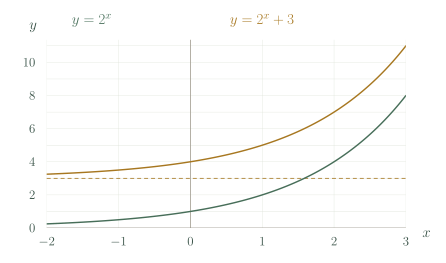
For a controlled parameter experiment, vary one parameter and keep the others fixed. Compare the same inputs, intercepts and asymptotes so that a change in the graph can be linked to that single parameter.
For example, is always above . Its outputs no longer double directly, but its distances above the new asymptote do: . This separates vertical shifting from a change of base.
See the method in action.
Shift right and down
For , find the horizontal asymptote and -intercept.
Worked solution
- 1
Identify the vertical translation.
The basic exponential approaches ; subtracting shifts that line down.
- 2
Set the input to zero.
The -intercept occurs on the vertical axis where .
- 3
Evaluate and state the intercept.
The negative exponent gives a reciprocal, followed by the vertical shift.
; intercept
Reflect and stretch
Compare with .
Worked solution
- 1
Apply the outside multiplier.
The negative sign reflects across the -axis and the factor doubles vertical distances.
- 2
Apply the vertical shift.
Adding moves every transformed point up one unit, so the asymptote is .
- 3
Determine which side of the asymptote contains the curve.
The transformed range is because the exponential factor is always positive.
- 4
Check the transformed intercept.
Substitution confirms the reflection, stretch and shift at a known input.
Reflection, vertical stretch by 2, then shift up 1.
Try it yourself.
Check your understanding
State the horizontal asymptote of .
Show answer & reasoning
In , the exponential term approaches in one direction. Adding moves the horizontal asymptote to .
Keep practising
6 worksheet questions · 14 marks
Read the questions online
- Find the -intercept of .2 marks
- State the shift from to .2 marks
- State the range of .2 marks
- Find the intercept and asymptote of .3 marks
- Compare with at . Give the outputs of the second graph.2 marks
- Explain why does not have consecutive output ratio 2, even though its exponential part does.3 marks
Read the worked solutions
Equivalent correct methods earn the corresponding marks. Include units where asked.
- Find the -intercept of .2 marks
.
- State the shift from to .2 marks
The inside change gives an earlier input.
Left 2 units - State the range of .2 marks
The exponential part is positive, so the result exceeds .
- Find the intercept and asymptote of .3 marks
At zero, ; the vertical shift sets the asymptote.
and - Compare with at . Give the outputs of the second graph.2 marks
Substitute the stated inputs; each is half the original output.
- Explain why does not have consecutive output ratio 2, even though its exponential part does.3 marks
At , outputs are , whose ratios are not constant. Distances above the asymptote are .
The constant shift changes output ratios.
Curriculum reference & lesson scope
Australian Curriculum v9 and SA Curriculum Mathematics
Integer and fractional index laws; connecting fractional powers with roots; simplifying surds; operations with surds; rationalising denominators; exact and approximate values; exponential tables and graphs; growth/decay factors; comparing linear/quadratic/exponential patterns; exponential equations; logarithms as inverses; logarithm laws; interpreting logarithmic scales; graph transformations and parameter experiments; choosing and evaluating models.
Official curriculum source ↗