
Understand the idea.
One function, three useful views
Each quadratic form highlights a different feature. Expanded form gives the vertical intercept ; real factored form gives the roots; vertex form gives the turning point . The coefficient controls opening and vertical scale.
These are alternative descriptions of the same function, so corresponding inputs must give the same output. Real root factors exist only when real roots exist; a repeated root supplies the same factor twice.
Choose the form before doing extra work
Choose a starting form that uses the given information. Two roots give ; a vertex gives . Substitute another suitable point to determine the remaining scale factor.
Convert by expanding, factorising or completing the square when another feature is needed. Keep a useful form visible rather than expanding automatically: a correct rule can often answer several questions directly.
See the method in action.
Connect all three forms
Write in factored and vertex forms.
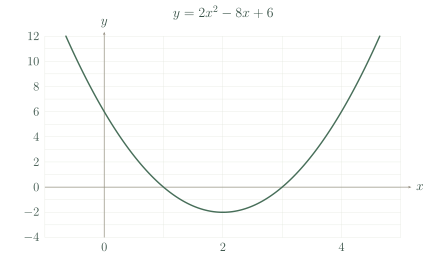
Worked solution
- 1
Remove the common factor.
Factoring out the leading coefficient leaves a monic quadratic.
- 2
Factor the monic quadratic.
The numbers and have product and sum .
- 3
Complete the square from the expanded form.
The square adds inside the brackets, so the compensation is multiplied by .
- 4
Read and connect the features.
The roots are symmetric about the vertex’s horizontal coordinate, consistent with both forms.
Build a model from roots
A parabola has roots and and passes through . Find its rule.
Worked solution
- 1
Build factors from the roots.
The factors must vanish at and .
- 2
Substitute the additional point.
The point fixes the scale that the roots alone cannot determine.
- 3
Solve for the leading coefficient.
Dividing by the nonzero product gives a unique scale factor.
- 4
State and verify the rule.
The rule has both required zero factors and passes through the supplied point.
Try it yourself.
Check your understanding
Which form shows the vertex directly: or ?
Show answer & reasoning
, giving vertex .
The vertex form displays the vertex because the square is zero at . Expanding gives , confirming the forms agree.
Keep practising
6 worksheet questions · 14 marks
Read the questions online
- Expand .2 marks
- Write in factored form.2 marks
- Write in vertex form.2 marks
- Write in expanded form.2 marks
- A parabola has roots 1 and 5 and passes through . Find its rule.3 marks
- A parabola has vertex and passes through . Find its rule.3 marks
Read the worked solutions
Equivalent correct methods earn the corresponding marks. Include units where asked.
- Expand .2 marks
The middle terms are .
- Write in factored form.2 marks
The factor pair is .
- Write in vertex form.2 marks
Add and subtract .
- Write in expanded form.2 marks
Expand the square before multiplying by .
- A parabola has roots 1 and 5 and passes through . Find its rule.3 marks
; , so .
- A parabola has vertex and passes through . Find its rule.3 marks
Use .
, giving .
Curriculum reference & lesson scope
Australian Curriculum v9.0 and South Australian Curriculum
Year 10 quadratics, including the fuller school-course algebra requested for Ascent: non-monic factorisation, completing the square and the quadratic formula. These lessons consolidate Year 9 monic quadratics and extend the available solving methods.
Official curriculum source ↗