
Understand the idea.
A sketch records the important structure
A quadratic sketch should communicate opening, vertex, symmetry and intercepts. Calculate and label these first; a pair of points at equal distances from the symmetry axis helps guide the curve.
Draw a smooth parabola through the features, using consistent spacing along each axis. The two axes may use different scales, but their labels must make the coordinates and the shape’s important features clear.
Check the rule and the window
Before trusting a graphing tool, check the entered rule against a few hand-calculated values. Brackets matter: squaring requires the whole expression inside the square.
Choose a window that contains the vertex and relevant intercepts. A cropped display can hide a root without removing it from the function. Use algebra for exact coordinates and label graphical readings as approximations.
See the method in action.
Sketch with a useful checklist
Sketch .
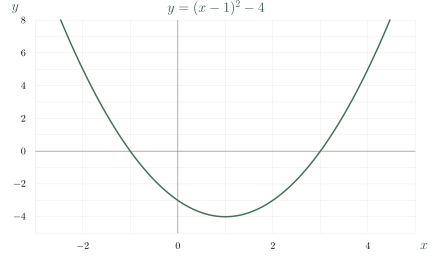
Worked solution
- 1
Locate the vertex and symmetry axis.
The positive square coefficient gives an upward-opening curve with a minimum.
- 2
Calculate the horizontal intercepts.
The intercepts are and , equally spaced from the axis.
- 3
Add a symmetric pair near the vertex.
The inputs and are each one unit from .
- 4
Sketch through the labelled points.
A smooth upward curve through these points records both symmetry and the minimum.
Upward parabola through .
A reflected and stretched parabola
Sketch .
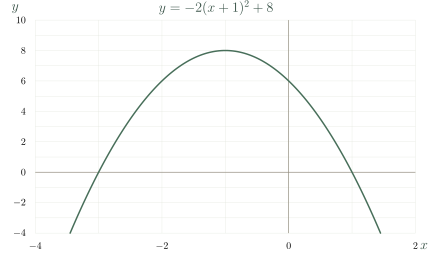
Worked solution
- 1
Read the opening and vertex.
The coefficient is negative, so the curve opens downward and its maximum height is eight.
- 2
Solve for the roots.
Both square-root branches are needed to locate the two intercepts.
- 3
Find a further symmetric pair.
The vertical intercept reflects across to .
- 4
Draw a smooth downward curve.
The labelled features fix the curve’s maximum, crossings and symmetry.
Downward parabola with axis , maximum , roots .
Try it yourself.
Check your understanding
Which features must a sketch of show?
Show answer & reasoning
Vertex , axis , y-intercept , no x-intercepts.
The minimum is at and the axis is . At , . Since , the output is always at least , so there are no horizontal intercepts.
Keep practising
6 worksheet questions · 17 marks
Read the questions online
- Sketch . Label the vertex and all intercepts.3 marks
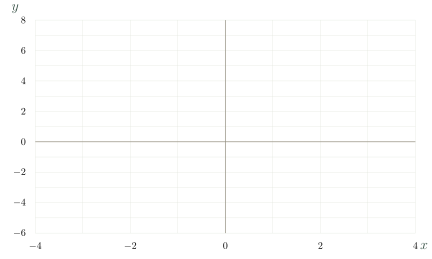
- Sketch . Label the vertex and all intercepts.3 marks
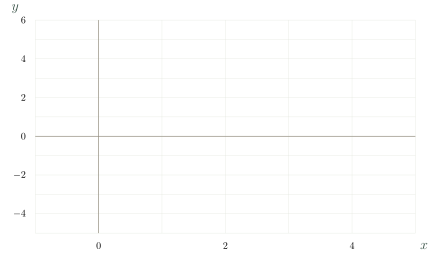
- Sketch . Explain why there are no -intercepts.3 marks
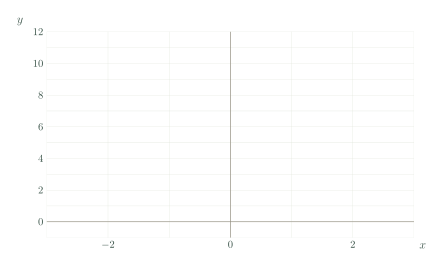
- Describe how to obtain from , then state the vertex.2 marks
- The table is intended for . Identify the incorrect entry and correct it.3 marks
One -value is incorrect. −1 0 1 2 3 0 −3 −4 −1 0 - A tool uses to graph and shows only one root. Find both roots and suggest a better horizontal window.3 marks
Read the worked solutions
Equivalent correct methods earn the corresponding marks. Include units where asked.
- Sketch . Label the vertex and all intercepts.3 marks
gives the roots; the -intercept equals the vertex.
Vertex ; roots ; upward opening.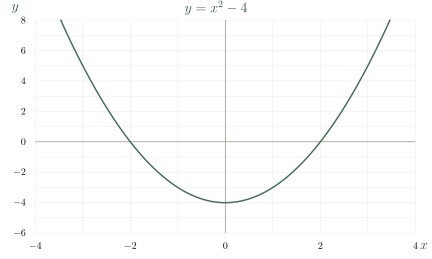
- Sketch . Label the vertex and all intercepts.3 marks
Set for the roots.
Vertex ; roots ; -intercept ; downward opening.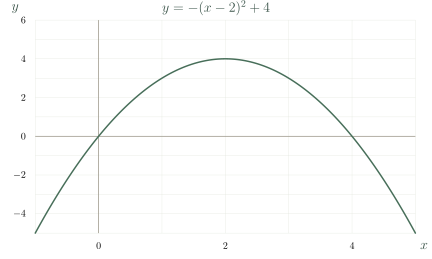
- Sketch . Explain why there are no -intercepts.3 marks
A real square cannot be negative, so cannot equal zero.
Vertex , upward opening; .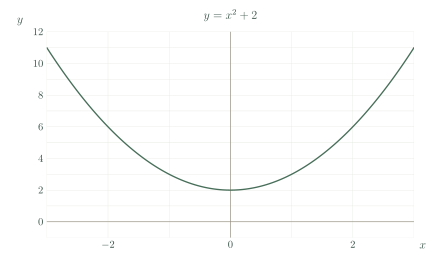
- Describe how to obtain from , then state the vertex.2 marks
The negative sign reverses -values; adding shifts them upward.
Reflect in the -axis and move up 3; vertex . - The table is intended for . Identify the incorrect entry and correct it.3 marks
One -value is incorrect. −1 0 1 2 3 0 −3 −4 −1 0 Substitute : .
The correct table is symmetric about .
At , , not . - A tool uses to graph and shows only one root. Find both roots and suggest a better horizontal window.3 marks
.
The second root is outside the original horizontal window; the axis is .
Roots ; for example .
Curriculum reference & lesson scope
Australian Curriculum v9.0 and South Australian Curriculum
Year 10 quadratics, including the fuller school-course algebra requested for Ascent: non-monic factorisation, completing the square and the quadratic formula. These lessons consolidate Year 9 monic quadratics and extend the available solving methods.
Official curriculum source ↗