
Understand the idea.
Intersections and symmetry
Roots are inputs for which , so their intercept points are . The vertical intercept instead comes from . Keeping inputs and coordinates separate makes graph labels precise.
A parabola mirrors across a vertical axis through its vertex. With two real roots, this axis lies halfway between them. Without roots, vertex form or still locates the axis.
A turning point is not a root
After finding the axis’s horizontal coordinate, substitute it into the rule to find the vertex’s height. Positive gives a minimum; negative gives a maximum. A vertex need not be an intercept.
For a model, apply the meaningful input range after finding its algebraic features. An unrestricted graph may have a root before launch or a vertex outside an allowed interval, so context determines which features are usable.
See the method in action.
Read a downward-opening graph
Find the main features of .
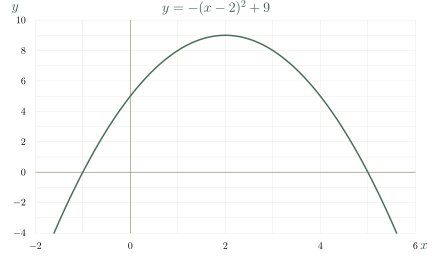
Worked solution
- 1
Read the vertex and opening.
The negative square term makes the maximum, attained when .
- 2
Set the height equal to zero.
Roots occur on the horizontal axis, where the output is zero.
- 3
Solve both branches.
The roots lie three units to either side of the symmetry axis .
- 4
Find the vertical intercept.
The vertical intercept is because its input is zero.
Roots ; y-intercept ; maximum at .
Use the midpoint of roots
Find the vertex of .
Worked solution
- 1
Find the two roots.
Each root makes one of the displayed factors zero.
- 2
Take their midpoint.
Symmetry places the vertex halfway between the two roots.
- 3
Calculate the vertex height.
Substituting the axis coordinate supplies the missing vertical coordinate.
- 4
State the vertex and axis.
The vertex is a point, while the symmetry axis is a vertical line.
Vertex ; axis .
Try it yourself.
Check your understanding
What are the vertex and axis of ?
Show answer & reasoning
Vertex ; axis .
The square is zero at . Hence the vertex is and its symmetry axis is ; the positive coefficient makes this a minimum.
Keep practising
6 worksheet questions · 19 marks
Read the questions online
- State the vertex, axis and minimum of .2 marks
- Find the roots and -intercept of .3 marks
- Find the vertex of .2 marks
- Find all intercepts and the vertex of .4 marks
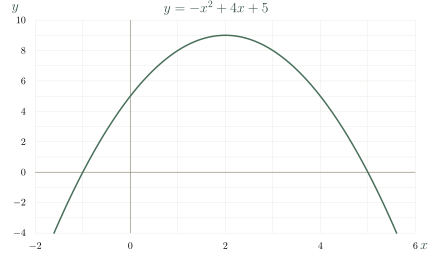
- The graph shown is . State its roots, axis and maximum.4 marks
- A ball has height metres for times from launch until it first reaches the ground. Find the greatest height and the landing time.4 marks
Read the worked solutions
Equivalent correct methods earn the corresponding marks. Include units where asked.
- State the vertex, axis and minimum of .2 marks
The squared term is zero at .
Vertex ; axis ; minimum . - Find the roots and -intercept of .3 marks
Set each factor to zero; then set .
Roots ; -intercept . - Find the vertex of .2 marks
The axis is ; substitute to get .
- Find all intercepts and the vertex of .4 marks
For roots, .
For the -intercept, use .
Roots ; -intercept ; vertex . - The graph shown is . State its roots, axis and maximum.4 marks
.
The midpoint of the roots is and .
Roots ; axis ; maximum . - A ball has height metres for times from launch until it first reaches the ground. Find the greatest height and the landing time.4 marks
, so the maximum is .
has roots ; use the non-negative landing time.
Greatest height m at s; landing at s.
Curriculum reference & lesson scope
Australian Curriculum v9.0 and South Australian Curriculum
Year 10 quadratics, including the fuller school-course algebra requested for Ascent: non-monic factorisation, completing the square and the quadratic formula. These lessons consolidate Year 9 monic quadratics and extend the available solving methods.
Official curriculum source ↗