
Understand the idea.
One constant links every pair
Two quantities are in direct proportion when the same multiplier scales them both. Their relationship is , where is constant. For each nonzero , dividing the paired value by must give this same .
The rule also gives when . For identical notebooks with no other charge, doubling the number doubles the cost. A fixed fee breaks this relationship: doubling the number would not double the fixed part of the bill.
Read the graph and the context
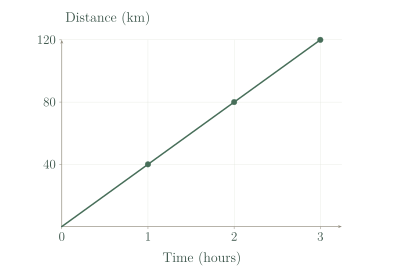
A direct-proportion graph is a straight line through the origin. Read both axis scales to find its unit rate. On the supplied travel graph, km is covered in one hour, giving the rule .
Keep the context in mind when using the rule. Time can take fractional values, but a notebook count uses whole numbers. A straight travel line assumes steady speed over the modelled interval; a stop or speed change needs another section.
See the method in action.
Build a cost rule
Notebooks cost AUD 4 each, with no other charge. Write a rule for the cost C of n notebooks.
| Notebooks n | Cost C (AUD) |
|---|---|
| 0 | 0 |
| 1 | 4 |
| 2 | 8 |
| 5 | 20 |
Worked solution
- 1
Identify the cost for one notebook.
Every notebook has the same price and there is no additional charge.
- 2
Multiply by the number bought.
A purchase of n notebooks contains n copies of the four-dollar cost.
- 3
Check zero and an entry in the table.
The rule matches the table; zero notebooks cost zero, with n restricted to nonnegative whole numbers.
.
Read a travel graph
Using the supplied steady-speed graph, find the distance after 2.5 hours.
Worked solution
- 1
Read a convenient point from the graph.
The labelled point gives the distance for one hour.
- 2
Write the steady-speed rule.
The straight line through the origin represents a constant rate of 40 km/h.
- 3
Substitute the requested time.
The time 2.5 hours lies on the supplied steady-speed section.
100 km.
Try it yourself.
Check your understanding
Does show direct proportion?
Show answer & reasoning
No.
No. Substituting into gives , so the graph does not pass through the origin and the rule cannot have the form .
Keep practising
6 worksheet questions · 12 marks
Read the questions online
- A table has -values 1, 2, 4 and -values 5, 10, 20. Find in .2 marks
- For , find when is 0, 2 and 5.2 marks
- Six identical tickets cost AUD 45 with no fee. Find the cost of nine tickets.2 marks
- Explain whether represents direct proportion.2 marks
- A table contains , , . Is directly proportional to ? Explain.2 marks
- Using the supplied graph, how long does it take to travel 80 km?2 marks
Read the worked solutions
Equivalent correct methods earn the corresponding marks. Include units where asked.
- A table has -values 1, 2, 4 and -values 5, 10, 20. Find in .2 marks
.
. - For , find when is 0, 2 and 5.2 marks
Multiply each -value by 7.
0, 14 and 35. - Six identical tickets cost AUD 45 with no fee. Find the cost of nine tickets.2 marks
Each ticket costs .
Nine cost .
AUD 67.50. - Explain whether represents direct proportion.2 marks
The ratio whenever .
The graph passes through .
Yes: the constant of proportionality is 6. - A table contains , , . Is directly proportional to ? Explain.2 marks
The ratios are 4, 3.5 and , which are not equal.
The rule has a nonzero starting value.
No. - Using the supplied graph, how long does it take to travel 80 km?2 marks
Read 80 km across to the line and down to the time axis.
Equivalently, .
2 hours.
Curriculum reference & lesson scope
Australian Curriculum v9 / SA Curriculum Mathematics
Ratio scaling and division review; unit rates; comparing rates and best buys; speed, distance and time; converting compatible units; direct-proportion tables and graphs; modelling practical rate problems and checking assumptions.
Official curriculum source ↗