
Understand the idea.
Horizontal lines fix the height
A horizontal line has the same height at every point. For , the second coordinate stays while the first may vary; , and are examples.
The equation describes an entire line, not just . Changing the first coordinate moves along that line without changing its height. The horizontal axis itself has equation .
Vertical lines fix horizontal position
A vertical line fixes horizontal position. On , every first coordinate is , while the second can vary. Points line up above and below one another, two units left of the vertical axis.
The vertical axis has equation . A vertical line has many heights for its one fixed input, so it cannot be expressed as a rule assigning one output to each input .
See the method in action.
A horizontal line
Give three points on .
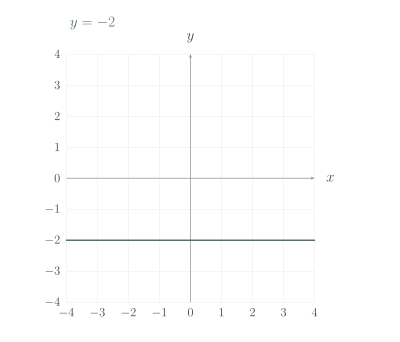
Worked solution
- 1
Keep the required second coordinate.
Every point on the line must have height negative two.
- 2
Choose three different first coordinates.
The equation places no restriction on the first coordinate.
- 3
Pair each input with that height.
All three points have the required second coordinate and lie on the same horizontal line.
For example .
A fixed first coordinate
A line contains . What is its equation?
Worked solution
- 1
Compare the first coordinates.
Each listed point has the same horizontal position.
- 2
Compare the second coordinates.
The heights vary, so the line extends vertically.
- 3
Write the fixed-coordinate equation.
These distinct points determine the vertical line three units right of the vertical axis.
.
Try it yourself.
Check your understanding
Give the equation of the x-axis.
Show answer & reasoning
.
Every point on the horizontal axis has height zero, such as and . Its equation is therefore .
Keep practising
6 worksheet questions · 12 marks
Read the questions online
- Give two points on .2 marks
- Give two points on .2 marks
- Which line is vertical: or ?2 marks
- A horizontal line passes through . Give its equation.2 marks
- A vertical line passes through . Give its equation.2 marks
- Where do and intersect?2 marks
Read the worked solutions
Equivalent correct methods earn the corresponding marks. Include units where asked.
- Give two points on .2 marks
Keep equal to 4.
Choose different -values.
For example . - Give two points on .2 marks
Keep equal to -1.
Choose different -values.
For example . - Which line is vertical: or ?2 marks
It fixes horizontal position.
Its -values vary.
. - A horizontal line passes through . Give its equation.2 marks
Use the point's constant -coordinate.
The -coordinate may vary.
. - A vertical line passes through . Give its equation.2 marks
Use the point's constant -coordinate.
The -coordinate may vary.
. - Where do and intersect?2 marks
The point must satisfy both equations.
Combine and .
.
Curriculum reference & lesson scope
Australian Curriculum v9 and SA Curriculum Mathematics (2026)
Multi-step equations; brackets and variables on both sides; equations with rational solutions; substitution checks; one-variable inequalities and number-line solutions; tables and straight-line graphs; horizontal/vertical lines; how coefficients change a graph; graphical solutions and intersection checks; real-world linear models with digital exploration.
Official curriculum source ↗