
Understand the idea.
Movements that preserve size
Translations, rotations and reflections are rigid transformations: they preserve all lengths and angles, so a shape and its image are congruent. In a translation, add the same horizontal change to every and the same vertical change to every .
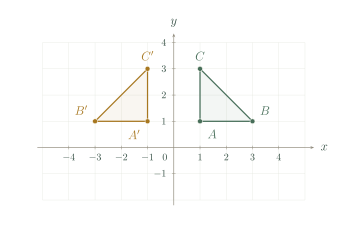
Reflection in the -axis uses . It reverses left and right while preserving height. The reflected triangles in the diagram have reversed orientation, but the same side lengths and corresponding angles.
Enlargement has a different effect
For an enlargement with centre the origin and positive factor , use . Both coordinates change by the same factor. Corresponding lengths multiply by , while corresponding angles stay equal.
The image is similar to the original and is congruent when . A positive factor other than 1 changes size. Stretching only a digital image's width generally changes its proportions, because its horizontal and vertical lengths no longer share one multiplier.
See the method in action.
Translate every vertex
Triangle ABC has A(1,2), B(4,2), C(1,4). Translate it 2 units right and 1 unit down. Find the image vertices.
Worked solution
- 1
Write one rule for the translation.
Moving right adds 2 to x; moving down subtracts 1 from y.
- 2
Apply the rule to A and B.
Every vertex receives the same horizontal and vertical changes.
- 3
Apply the same rule to C.
Keeping one rule for all vertices preserves the triangle's lengths and angles.
- 4
State the images and their relationship.
The translation is rigid, so the image triangle is congruent to ABC.
A′(3,1), B′(6,1), C′(3,3).
Compare an enlargement
A rectangle has vertices (0,0), (2,0), (2,1), (0,1). Enlarge it by factor 3 about the origin.
Worked solution
- 1
Write the origin-centred enlargement rule.
A factor of 3 multiplies both coordinates relative to the origin.
- 2
Transform the first two vertices.
The centre stays fixed, and the 2-unit horizontal side becomes 6 units.
- 3
Transform the remaining vertices.
The vertical coordinates triple as well, so the height becomes 3 units.
- 4
Compare size and shape.
Both side dimensions triple, giving a similar rectangle of different size, so it is not congruent.
(0,0), (6,0), (6,3), (0,3); similar with factor 3.
Try it yourself.
Check your understanding
Reflect point (4,−2) in the y axis.
Show answer & reasoning
(−4,−2).
Reflection in the vertical -axis changes the horizontal coordinate's sign and preserves height: .
Keep practising
6 worksheet questions · 13 marks
Read the questions online
- Translate point 5 units right and 2 units down.2 marks
- Reflect point in the axis.2 marks
- Enlarge point by factor 4 about the origin.2 marks
- A triangle is rotated 90° without changing its size. Is the image congruent, similar, both or neither?2 marks
- An image is stretched from width 4 cm and height 3 cm to width 8 cm and height 3 cm. Is it similar? Explain.2 marks
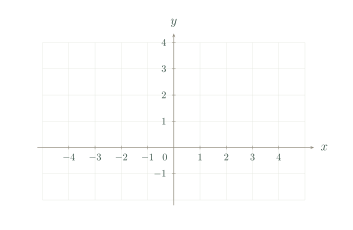
- Triangle has , , . Plot its image after translation 1 unit right and 2 units up.3 marks
Read the worked solutions
Equivalent correct methods earn the corresponding marks. Include units where asked.
- Translate point 5 units right and 2 units down.2 marks
and .
. - Reflect point in the axis.2 marks
The coordinate stays −3; the coordinate changes sign.
. - Enlarge point by factor 4 about the origin.2 marks
Multiply both coordinates by 4.
. - A triangle is rotated 90° without changing its size. Is the image congruent, similar, both or neither?2 marks
Rotation preserves lengths and angles.
Congruence is similarity with scale factor 1.
Both. - An image is stretched from width 4 cm and height 3 cm to width 8 cm and height 3 cm. Is it similar? Explain.2 marks
The width factor is 2 but the height factor is 1.
Corresponding dimensions do not share one factor.
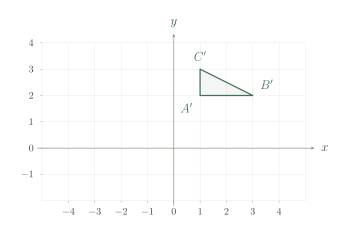
No. - Triangle has , , . Plot its image after translation 1 unit right and 2 units up.3 marks
Apply to all three vertices.
Plot and join the three image points.
, , .
Curriculum reference & lesson scope
Australian Curriculum v9 / SA Curriculum
Congruent shapes and matching parts; triangle congruence tests; similar shapes and corresponding sides; triangle similarity; properties of quadrilaterals established using triangles; testing congruence/similarity with transformations; decision-tree algorithms and digital geometry.
Official curriculum source ↗