
Understand the idea.
Make a useful plan
For a composite area, choose familiar regions that cover the shape exactly once. Add regions that join without overlap, or subtract a missing region from a larger shape. A sketch helps show which areas belong in the calculation.
In the L-shaped diagram, the enclosing rectangle has area . The removed square has area . Subtracting leaves ; the construction lines do not change the region.
Trace the perimeter
For perimeter, trace the exposed boundary once, including any inward corners. Lines drawn just to divide the area are internal and are not counted. Label missing boundary lengths from the given dimensions before adding.
A semicircle has a curved edge and a straight diameter. Its arc is half a full circumference, , and its diameter is . Therefore its full perimeter is , while its area is .
See the method in action.
Subtract a missing corner
A rectangle is 12 cm by 8 cm. A 4 cm by 3 cm rectangle is cut from one corner. Find the remaining area.
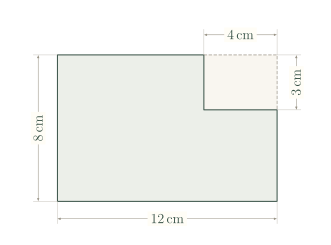
Worked solution
- 1
Find the area before the corner is removed.
A rectangle's area is length multiplied by width.
- 2
Find the area of the cut-out.
Only the smaller rectangular region is removed.
- 3
Subtract the missing area.
The remaining region and the cut-out together make the original rectangle.
84 cm².
A straight edge matters
A semicircular window has radius 4 cm. Find its area and its full perimeter exactly.
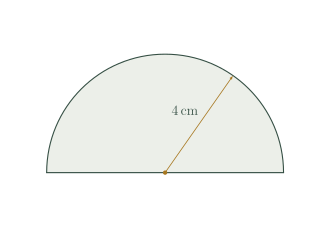
Worked solution
- 1
Find half the circle's area.
A semicircle covers half of the corresponding full circle.
- 2
Find the curved boundary.
The curved edge is half the full circumference.
- 3
Find the straight boundary.
The straight edge is the diameter.
- 4
Add both boundary parts.
The full perimeter includes the arc and the straight edge.
Area cm²; perimeter cm.
Try it yourself.
Check your understanding
Two rectangles of areas 18 cm² and 12 cm² join along an edge without overlapping. What is the total area?
Show answer & reasoning
30 cm².
The rectangles do not overlap, so their areas add: . Joining along a line creates no overlapping area.
Keep practising
6 worksheet questions · 16 marks
Read the questions online
- A 10 cm by 6 cm rectangle has a 2 cm by 3 cm corner removed. Find the area.2 marks
- Two non-overlapping rectangles have dimensions 8 m by 3 m and 4 m by 5 m. Find their combined area.2 marks
- Find the area of a semicircle of radius 6 cm.2 marks
- Find the full perimeter of a semicircle of radius 3 m.3 marks
- An L shape is made by removing a 3 cm by 2 cm top-right corner from a 9 cm by 5 cm rectangle. Find its area and perimeter.4 marks
- A 6 m by 4 m garden contains a circular bed of radius 1 m. Find the area outside the bed.3 marks
Read the worked solutions
Equivalent correct methods earn the corresponding marks. Include units where asked.
- A 10 cm by 6 cm rectangle has a 2 cm by 3 cm corner removed. Find the area.2 marks
cm².
54 cm². - Two non-overlapping rectangles have dimensions 8 m by 3 m and 4 m by 5 m. Find their combined area.2 marks
m².
44 m². - Find the area of a semicircle of radius 6 cm.2 marks
cm².
cm². - Find the full perimeter of a semicircle of radius 3 m.3 marks
Curved length is m.
Straight diameter is 6 m.
Add to obtain m.
m. - An L shape is made by removing a 3 cm by 2 cm top-right corner from a 9 cm by 5 cm rectangle. Find its area and perimeter.4 marks
Area: cm².
The missing outer lengths are replaced by equal inward lengths.
Perimeter remains cm.
Area 39 cm²; perimeter 28 cm. - A 6 m by 4 m garden contains a circular bed of radius 1 m. Find the area outside the bed.3 marks
Rectangle area: m².
Circle area: m².
Subtract the bed area.
m².
Curriculum reference & lesson scope
Australian Curriculum v9 / SA Curriculum
Circumference and area of circles; perimeter/area of composite shapes; choosing and converting area units; cross-sections of prisms; prism volume and capacity; mixed measurement applications.
Official curriculum source ↗