
Understand the idea.
One point satisfies both rules
An intersection is an ordered pair that satisfies both graph rules. Its first coordinate is a common input and its second is their common output. Give both coordinates when identifying the point.
Plotting can suggest where two lines meet, but a grid reading may only be approximate. At an exact intersection, the two output expressions are equal; solve that equality and substitute back to find the output.
Recognise when a picture is approximate
A crossing between grid lines may have fractional coordinates. Report an approximate graph reading honestly, then use algebra if you need an exact value. Checking both original rules verifies that the proposed point lies on each.
Two different parallel lines never meet because they have equal rates and different vertical-axis crossings. Identical lines overlap everywhere, so every point on the line is common rather than there being one intersection.
See the method in action.
A visible common point
Find the intersection of and .
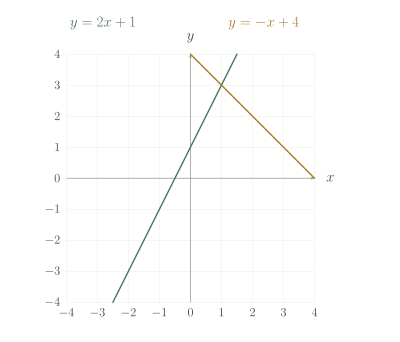
Worked solution
- 1
Set the output expressions equal.
At an intersection, both rules must assign the same output to the same input.
- 2
Gather terms and solve for the input.
Add to both sides, subtract , then divide by .
- 3
Find and check the common output.
Both original rules produce the same height.
- 4
State the intersection as a point.
The input is the first coordinate and the common output is the second.
.
A horizontal partner
Find the intersection of and .
Worked solution
- 1
Use the horizontal line's fixed output.
Every point on the second graph has height four.
- 2
Put that output into the other rule.
The common point must also satisfy the first equation.
- 3
Subtract 2 and verify the output.
This input gives the required height in the first rule as well.
- 4
Write the ordered pair.
Both original equations hold at this point.
.
Try it yourself.
Check your understanding
Does lie on both and ?
Show answer & reasoning
Yes.
At , the first rule gives , and the second gives . Both match the proposed second coordinate, so lies on both graphs.
Keep practising
6 worksheet questions · 14 marks
Read the questions online
- Verify that lies on and .2 marks
- Find the intersection of and .2 marks
- Find the intersection of and .2 marks
- Find the intersection of and .2 marks
- A crossing of and is read as . Use checks to assess this.3 marks
- Can and intersect? Explain.3 marks
Read the worked solutions
Equivalent correct methods earn the corresponding marks. Include units where asked.
- Verify that lies on and .2 marks
First output: .
Second output: .
It lies on both. - Find the intersection of and .2 marks
Solve .
Then and .
. - Find the intersection of and .2 marks
Set , giving .
The shared output is 4.
. - Find the intersection of and .2 marks
Set , giving .
Substitute to get .
. - A crossing of and is read as . Use checks to assess this.3 marks
Both rules give 5 at .
The proposed works, but the -reading is one unit too high.
The correct point is . - Can and intersect? Explain.3 marks
At every input the first output is 4 larger.
The graphs are parallel distinct lines.
No.
Curriculum reference & lesson scope
Australian Curriculum v9 and SA Curriculum Mathematics (2026)
Multi-step equations; brackets and variables on both sides; equations with rational solutions; substitution checks; one-variable inequalities and number-line solutions; tables and straight-line graphs; horizontal/vertical lines; how coefficients change a graph; graphical solutions and intersection checks; real-world linear models with digital exploration.
Official curriculum source ↗