
Understand the idea.
Move a point without changing its shape
An ordered pair gives horizontal position first and vertical position second. For a translation, change each coordinate by the stated movement: right and up add; left and down subtract. Begin with the point's actual coordinates, including any negative signs.
When translating a whole shape, use the same coordinate changes for every vertex. Check one point by counting the movement on a grid, then apply that rule consistently. Equal movements preserve the shape's lengths, angles and orientation.
Reflect or rotate about a stated reference
A reflection needs a mirror line. In the -axis, use because left and right reverse. In the -axis, use because above and below reverse. Points on the mirror line remain fixed.
A quarter-turn also needs a centre and direction. About the origin, anticlockwise uses , while clockwise uses . For successive transformations, apply the second rule to the first image.
See the method in action.
A translation
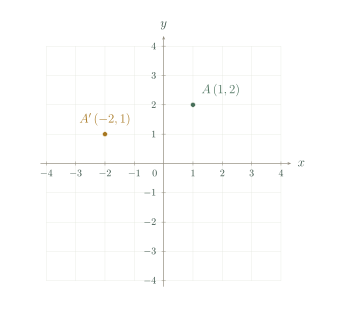
Translate A(1,2) three units left and one unit down.
Worked solution
- 1
Write the horizontal change.
Three units left decreases the horizontal coordinate by 3.
- 2
Write the vertical change.
One unit down decreases the vertical coordinate by 1.
- 3
Combine the image coordinates in order.
The first entry gives horizontal position and the second gives vertical position.
A′(−2,1)
A reflection followed by a turn
Reflect P(−3,2) in the y-axis, then rotate the image 90° anticlockwise about the origin.
Worked solution
- 1
Reflect the point in the y-axis.
Reflection in the vertical axis reverses x and leaves y unchanged.
- 2
Write the anticlockwise quarter-turn rule.
This rule applies to a 90-degree anticlockwise rotation about the origin.
- 3
Rotate the reflected image.
The second transformation starts from the intermediate point, giving the final image .
Final image (−2,3).
Try it yourself.
Check your understanding
Reflect (4,−1) in the x-axis.
Show answer & reasoning
(4,1)
The -axis is the horizontal mirror. Keep and reverse the sign of , giving .
Keep practising
6 worksheet questions · 12 marks
Read the questions online
- Translate four units right and two units down.2 marks
- Reflect in the -axis.2 marks
- Reflect in the -axis.2 marks
- Rotate 90° anticlockwise about the origin.2 marks
- moves to . State the translation.2 marks
- is reflected in the -axis. Explain why it does not move.2 marks
Read the worked solutions
Equivalent correct methods earn the corresponding marks. Include units where asked.
- Translate four units right and two units down.2 marks
and .
- Reflect in the -axis.2 marks
Change to its opposite; leave unchanged.
- Reflect in the -axis.2 marks
Leave unchanged; change the sign of .
- Rotate 90° anticlockwise about the origin.2 marks
Use .
- moves to . State the translation.2 marks
; .
4 units right and 3 units down. - is reflected in the -axis. Explain why it does not move.2 marks
Reflection changes to ; .
Its image is , because it lies on the mirror line.
Curriculum reference & lesson scope
Australian Curriculum v9 and SA Curriculum Mathematics
Coordinate transformations review; identifying positions using three coordinates; interpreting 3D axes; describing routes and relative positions; comparing diagrams, views and digital representations. This is spatial location, not senior vector algebra.
Official curriculum source ↗