
Understand the idea.
Define the viewing direction
A flat view hides one coordinate, so first state the viewing convention. Here, front means looking along and showing ; side means looking along and showing ; top means looking along and showing .
Keep the names of the retained axes attached to each pair. For , the front view keeps across and height, the side keeps depth and height, and the top keeps across and depth. Dropping an entry does not reorder the others.
| View | Shown coordinates | Hidden coordinate |
|---|---|---|
| Front | (3,4) on x,z | y=2 |
| Side | (2,4) on y,z | x=3 |
| Top | (3,2) on x,y | z=4 |
Compare representations rather than appearances
Different 3D points can overlap in one view because their hidden coordinates differ. Points and both appear at in the front view. Another view can reveal their different depths.
To combine views, assign every shown number to its named axis and check shared coordinates agree. A rotated screen view can look different while preserving the same stored triple. Coordinates change only if the point or its reference coordinate system changes.
See the method in action.
Three views of one point
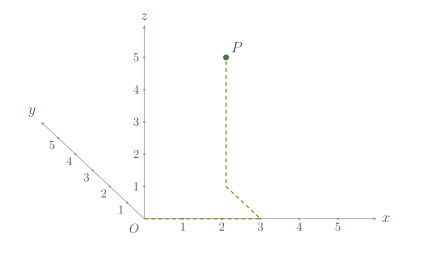
Find the front, side and top views of P(3,2,4), using front=(x,z), side=(y,z) and top=(x,y).
Worked solution
- 1
Keep x and z for the front view.
Looking along y hides the depth coordinate 2.
- 2
Keep y and z for the side view.
Looking along x hides the across coordinate 3.
- 3
Keep x and y for the top view.
Looking along z hides the height coordinate 4, giving front , side and top .
Front (3,4); side (2,4); top (3,2).
Combine two views
A point has front view (4,2) on x,z and top view (4,3) on x,y. Find its triple.
Worked solution
- 1
Read the coordinates supplied by the front view.
The front pair's second entry is height, not depth.
- 2
Read the coordinates supplied by the top view.
The top view supplies the missing depth and agrees with the front view's x-coordinate.
- 3
Assemble the coordinates in their fixed order.
The combined views determine all three entries of the point.
(4,3,2).
Try it yourself.
Check your understanding
What is the top view of (2,5,3) on x,y?
Show answer & reasoning
(2,5)
The top view retains and while hiding . Therefore appears at on the top-view axes.
Keep practising
6 worksheet questions · 12 marks
Read the questions online
- Find the front view of , where front shows .2 marks
- Find the side view of , where side shows .2 marks
- Find the top view of , where top shows .2 marks
- Front view on is ; top view on is . Find the triple.2 marks
- Do and overlap in a front view on ? Explain.2 marks
- A digital model is rotated on screen. Its coordinate axes rotate with it. Must a stored point’s coordinate triple change? Explain.2 marks
Read the worked solutions
Equivalent correct methods earn the corresponding marks. Include units where asked.
- Find the front view of , where front shows .2 marks
Retain the first and third coordinates.
- Find the side view of , where side shows .2 marks
Retain the second and third coordinates.
- Find the top view of , where top shows .2 marks
Retain the first and second coordinates.
- Front view on is ; top view on is . Find the triple.2 marks
Front gives , ; top gives .
- Do and overlap in a front view on ? Explain.2 marks
The view hides .
Yes; both show , though their -coordinates differ. - A digital model is rotated on screen. Its coordinate axes rotate with it. Must a stored point’s coordinate triple change? Explain.2 marks
Distinguish the screen view from a change of coordinate system.
No. Rotating the view alone does not change coordinates relative to the same axes.
Curriculum reference & lesson scope
Australian Curriculum v9 and SA Curriculum Mathematics
Coordinate transformations review; identifying positions using three coordinates; interpreting 3D axes; describing routes and relative positions; comparing diagrams, views and digital representations. This is spatial location, not senior vector algebra.
Official curriculum source ↗