
Understand the idea.
Build volume from area
A right prism repeats one cross-section along its length, giving volume . First find the end's area , then multiply by the perpendicular distance between the ends. For a right cylinder this becomes .
Use consistent length units throughout. An area in multiplied by a length in produces . A circumference is only a length, so multiplying circumference by height cannot give a volume.
Connect volume and capacity
Capacity is the volume a container can hold. The connections are , and . Calculate the internal volume before converting its unit.
Check whether dimensions describe the inside or outside of a container. Thick walls occupy space, so outside measurements can overstate capacity. Use supplied internal dimensions, and keep an exact multiple of when an exact capacity is requested.
| Volume | Capacity |
|---|---|
| 1 cm³ | 1 mL |
| 1000 cm³ | 1 L |
| 1 m³ | 1000 L |
See the method in action.
A triangular prism
A triangular prism has cross-section base 6 cm, perpendicular height 4 cm and length 9 cm. Find its volume.
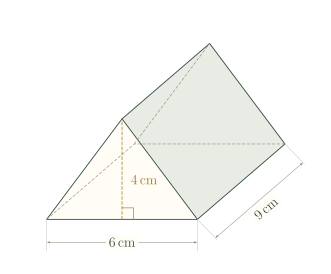
Worked solution
- 1
Find the triangular cross-sectional area.
The base and its perpendicular height describe the repeated triangular end.
- 2
Use the distance between the ends.
The same cross-section continues for the full 9-centimetre prism length.
- 3
Calculate the volume.
Square centimetres multiplied by centimetres give cubic centimetres.
108 cm³.
A cylinder
A cylindrical container has internal radius 3 cm and height 7 cm. Find its volume exactly and its capacity in mL.
Worked solution
- 1
Find the circular cross-sectional area.
The internal radius determines the area available inside each layer.
- 2
Multiply by the internal height.
The cylinder repeats that circular area over a height of 7 centimetres.
- 3
Convert volume to capacity.
Each cubic centimetre holds one millilitre, so the numerical value stays the same.
cm³, equivalent to mL.
Try it yourself.
Check your understanding
A prism has cross-sectional area 12 cm² and length 5 cm. What is its volume?
Show answer & reasoning
60 cm³.
Multiply the repeated cross-sectional area by the prism length: . The units are cubic because .
Keep practising
6 worksheet questions · 15 marks
Read the questions online
- Find the volume of a rectangular prism 8 cm by 3 cm by 2 cm.2 marks
- A prism has cross-sectional area 15 m² and length 4 m. Find its volume.2 marks
- A triangular prism has cross-section base 10 cm, perpendicular height 6 cm and length 8 cm. Find its volume.3 marks
- Find the volume of a cylinder with radius 2 m and height 5 m.2 marks
- A container holds 3500 cm³. Express its capacity in litres.2 marks
- A rectangular tank holds 240 L. Its internal base is 0.8 m by 0.5 m. Find its internal height.4 marks
Read the worked solutions
Equivalent correct methods earn the corresponding marks. Include units where asked.
- Find the volume of a rectangular prism 8 cm by 3 cm by 2 cm.2 marks
cm³.
48 cm³. - A prism has cross-sectional area 15 m² and length 4 m. Find its volume.2 marks
m³.
60 m³. - A triangular prism has cross-section base 10 cm, perpendicular height 6 cm and length 8 cm. Find its volume.3 marks
Cross-sectional area is cm².
Volume is cm³.
240 cm³. - Find the volume of a cylinder with radius 2 m and height 5 m.2 marks
m³.
m³. - A container holds 3500 cm³. Express its capacity in litres.2 marks
L.
3.5 L. - A rectangular tank holds 240 L. Its internal base is 0.8 m by 0.5 m. Find its internal height.4 marks
240 L is 0.24 m³.
Base area is m².
Height is m.
0.6 m.
Curriculum reference & lesson scope
Australian Curriculum v9 / SA Curriculum
Circumference and area of circles; perimeter/area of composite shapes; choosing and converting area units; cross-sections of prisms; prism volume and capacity; mixed measurement applications.
Official curriculum source ↗